Welcome to our website.
This website is all about the fund raising efforts of
alumni and friends of All Saints Mission School of
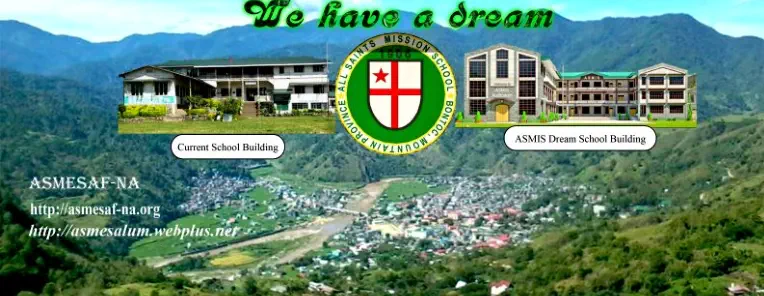
Mountain Province, Inc (ASMIS) towards helping
their alma mater realize it’s dream curriculum and
school building.
ASMIS believes that the best way for school kids
of indigenous communities in Northern Philippines
to catch up with main stream Philippine society
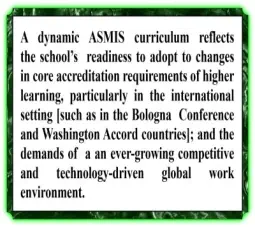
and the rest of the world is through a dynamic
quality education curiculum forged along
internatiional standards and the demands of an
ever groing competitive technology-driven global
work environment.
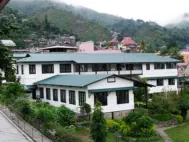
Replacing the dilapidated school buildings;
modernizing the class rooms as well as installing a
computer lab, science lab, digitized library,
auditorium and other facilities are necessary to
realize the dream curriculum.
Please read more about our school dream and the
initiatives we have lined up towards helping realize
the ASMIS school dream.
We hope and pray that our initiatives will be
worthy beneficiaries of your charitable donations /
support.
- - - - -
Note:
ASMIS
is
the
preferred
acronym
for
All
Saints
Mission
School
of
Mountain
Province,
Inc.
when
it
got
incorporated
to,
among
others,
pave
the
way
for
the
establishment
of
its
kindergarten
and
high
school
departments
.
The
previous
acronym
was
“ASMES”
which
stands
for
All
Saints
Mission Elementary School.



We
are
alumni
and
friends
of
All
Saints
Mission
School
of
Mountain
Province,
Inc.,
residing
in
the
United
States
and Canada.
The
majority
of
us
trace
our
indigenous
roots
to
the
hinterland
communities
in
the
mountain
ridges
of
the
Philippine
Cordilleras
in
Northern
Luzon,
Philippines.
Our
people
have
been
conferred
several
names
by
historians
and/or
civil
authorities
-
i.
e.,
Igorots,
Non-
Christian
Tribes,
Cultural
Minorities
and
now
“Cordillerans”.
Our
people
resisted
more
than
3
centuries
of
subjugation
attempts
by
Spanish
colonizers
and
were
successfully
brought
under
civil
authorities
only
during
the
American
colonial
government.
This
had
its
heavy
socio-economic
costs
for
our
people.
We
were
left
behind
in
all
facets
of
socio-economic
development:
schools,
roads
and
bridges,
hospitals,
clinics,
irrigation,
electricity, piped water sources, among other things.
Thanks
in
large
part
to
the
American
and
European
Missionaries
who
ventured
into
our
hinterland
communities
after
the
Spanish
Colonial
Administration
and
introduced
schools,
hospitals
and
clinics,
among
other aspects of western civilization.
Consequently,
many
Igorot
children
were
able
to
educate
themeselves
and
leapfrog
into
the
20th
century
as
teachers,
priests,
engineers,
nurses,
doctors,
lawyers,
accountants,
economists,
soldiers,
musicians, artists, you-name-it-we-have-it professions.
During
the
last
15
years
or
so,
however,
the
schools
established
by
the
American
Missionaries
have
been
overcome
by
developments
adverse
to
their
financial
viability.
The
proliferation
of
free
public
school,
in
particular,
siphoned
a
large
segement
of
would-be
enrollees
from
Episcopal
mission
schools
to
public
schools throwing the former in dire financial deficits.
Some
Episcopal
mission
schools
have
already
been
closed
and
the
Episcopal
Diocese
of
Northern
Philippines
have
seriously
considered
closing
their
few
remaining schools.
We
are
supportive
of
current
efforts
to
save
All
Saints
Mission
School
of
Mountain
Province,
Inc.
[ASMIS]
together
with
its
sister
Episcopal
Mission
Schools.
These
schools
have
been,
and
can
continue
to
be,
fountainheads of quality education in Ka-Igorotan.
Dr.
Dennis
Faustino,
the
US
Educated
and
current
headmaster
of
ASMIS
and
St.
Mary’s
School
of
Sagada
[SMSSI]
has
crafted
development
plans
for
these
schools
patterned
after
International
School,
Manila
where
he
was
once
assistant
principal.
He
is
being
groomed
to
become
headmaster
of
a
federation
of
About Us and what we are trying to accomplish.
Episcopal
Mission
schools
north
of
Baguio
City;
and,
no
doubt,
he
ambitions
similar
plans
for
St.
James
School
of
Mountain
Province,
Inc
[SJSMPI]
and
St.
Paul’s
School in Balbalasang, Kalinga [SPB].
We
have
been
hopeful
that
there
would
be
enough
parents
who
are
willing
to
pay
tuition
fees
if
they
are
convinced
of
the
quality
education
their
children
would
be
receiving.
We
are
excited
that
this
has
been
the
case
for
ASMIS.
Notwithstanding
the
increase
in
tuition
fees,
enrollment
registered
a
significant
increase
and
for
the
1st
time
in
many
years,
the
school
had
been
showing
modest
surpluses
from
school
year
2012-2013
up to the present (SY 2014-2015).
We
are
excited
that
Philippine
Department
of
Education
Officials
have
taken
cognizance
of
Dr.
Faustino’s
trail
blazing
efforts
towards
raising
the
bar
of
quality
education
in
Ka-Igorotan.
They
enlisted
him
to
join
a
team
of
experts
to
craft
a
curriculum
for
the
Philippine’s
K-12
program.
The
program
was
signed
into law by President Benigno Aquino on May 5, 2013.
Since
then,
Dr.
Faustino
has
been
going
all
over
the
Mountain
Province
School
District
training
heads
of
schools
[both
from
the
public
and
private
schools]
on
how
to
administer
the
K-12
program
as
well
as
conduct
seminars or worshops on best teaching methodologies.
ASMIS
and
SMSS
became
training
venues
and
together
with
SJSMPI
and
three
other
public
schools
were
recognized as pilot schools of the K-12 program.
The
realization
of
the
ASMIS
dream
curriculum
and
building
will
further
cement
ASMIS
relevancy
in
the
quest
for
raising
the
bar
of
quality
education
in
the
Mountain
Province
School
District
and
the
Cordillera
Administrative Region if not the entire Philippines.
For
the
sake
of
an
economically
marginalized
indigenouts
people
valiantly
striving
to
catch
up
with
mainstream
Philippine
society
and
the
rest
of
the
world,
we
appeal
for
your
support
in
our
efforts
to
help
realize
the
ASMIS
dream
curriculum
and
building.
You
can
read
more
about
this
in
the
“ASMIS
Page”
of
this
website.

Under Construction

contd. on 111. Breif History
All Saints Mission School
of Mountain Province, Inc. (ASMIS)
by Dr. Dennis Faustino
I. Mission Statement and Objectives
.
All
Saints
Mission
School
of
Mountain
Province,
Inc.
(ASMIS),
a
church
related
school,
is
committed
to
offer
and
foster
an
education
which
seeks
to
promote
the
development
of
the
whole
person
-
mind,
body
and
character.
Thus
it
offers
a
well-
balanced and
dynamic curriculum
to help the ASMIS pupil:
1
.
Develop a creative and critical mind.
2
.
Develop integrity and personal discipline.
3
.
Discover and develop his special and personal aptitudes.
4
.
Value
and
appreciate
the
arts
of
his/her
own
indigenous
culture
and
others,
as
well
as
an
interest
in
scientific
and
technical development; and
5
.
Develop
a
sense
of
commitment
to
Christian
values
and
the needs of society.
II. The school profile
All
Saints
Mission
School
is
located
in
Bontoc,
the
capital
town
of
Mountain
Provice.
Enrollment
is
in
accordance
with
the
church’s
guiding
principle
of
inclusiveness,
and
thus
is
open
to
all
children
regardless
of
religion,
race,
or
social
status.
For
SY
2014-2015,
it
is
the
home
of
345
students,
14
regular
faculty,
1
part-time
teacher,
and
2
in
administration
and
office
staff
which
includes
2
security
officers.
According
to
last
year’s
statisctics,
45%
of
the
student
body
is
Episcopalian,
40%
Roman
Catholic,
and
the
rest
are
from
other
Protestant
affiliations.
The
economic
profiles
show
that
children
come
from
a
wide
range
of
economic
backgrounds:
from
households
which
derive
income
from
professional
government
service
and
private
business,
all
the
way
to
rank-and-file
contractual
service,
small
entrepreneurial
endeavors,
and
overseas
employmnet.
The
annual
school
tuition
fee
is
only
PhP8,000
(US$200)
for
SY
2014-2015
to
be
increased
to
PhP9,000
(US$225.00)
for
SY
2015-2016.
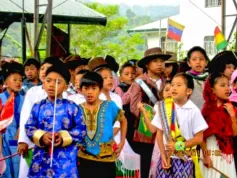
ASMIS kids in different
ethnic attires during
International Day
festivities.
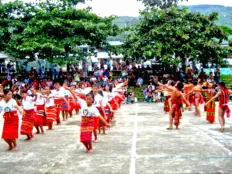
ASMIS kids, performing
Igorot dance and music
during cultural day
festivities.















I
II. Brief History
ASMIS
was
incorported
in
November,
2011,
as
a
successor
to
All
Saints
Mission
Elementary
School
(ASMES)
which
was
founded
in
1906
by
Bishop
Charles
Brent
and
the
Reverend
Walter
Clapp
of
the
Episcopal
Church
of
the
United
States
of
America
(ECUSA).
Headhunting
forays
were
still
the
national
pastime
of
the
Igorot
tribal
communities
during
the
coming
of
the
American
Missionaries.
Three
centuries
of
attemps
by
the
Spanish
colonizers
to
bring
the
warring
Igorot
tribes
under
civil
authority
mainly
through
military
subjugation
proved
futile.
Thus,
the
vision
of
the
American
missionaries
focused
on
the
pacification
of
the
Igorots
in
the Cordilleras through evangelization and education.
Bontoc,
considered
then
as
the
most
warlike
and
most
feared
tribe
was
chosen
as
a
center
for
evangelization
and
education.
The
missionaries
initially
offered
free
instruction
in
religious,
academic,
and
voacational
courses,
as
well
as
Kindergarten
and
Grade
1
after
which
children
continued
studies
in
government
established
schools.
After
World
War
II
which
saw
the
destruction
of
all
the
mission
buildings,
except
for
the
girl’s
dormitory,
the
mission
underwent
rehabilitation
for
fifteen
years.
Finally,
in
1955,
the
elementary
school
was
re-
established,
and
a
complete
elementary
program
was
implemented.
The
post-war
decades
saw
the
development
of
a
high
standard
institution
that
produced
exceptional
graduates
who,
after
receiving
well-grounded
educational
foundation
in
academic
and
Christian
values,
successfully
proceeded
to
secondary
and
tertiary
public
and
private
colleges
and
universities.
Many
alumni
of
the
school
went
on
to
distinguish
themselves
in
their
chosen
fields
of
endeavor.
Perhaps,
the
most
prominent
was
Dr.
Hilary Pitapit Clapp,
the first Igorot doctor of medicine.
The
missionary
thrust
of
evangelization
and
education
proved
successful
since
headhunting
and
tribal
wars
have
been
completely
eradicated
in
the
sub-province
of
Bontoc
which
has
since
become
the
Mountain
Province.
In
contrast,
headhunting
and
tribal
conflicts
in
some
hinterland
communities
in
Kalinga
and
elsewhere
in
the
Philippine
Cordilleras,
where
missionary
evangelization
and
education
did
not
reach,
continue
to
pose
problems
for
the
civil
and
miltary authorities.
ASMES
joined
other
Christian
schools
in
the
cordilleras
in
the
formation
of
the
Associaion
of
Chritian
Schools
and
Colleges
(ACSC),
now
renamed
ACSCU,
to
include
accredited
universities.
In
1988
ASMES
was
accredited
by
the
Accrediting
Agency
of
ACSC
and
DECS
(DepEd).
Upon
the
retirement
of
Principal
Sofia
Bacwaden
and
other
dynamic
teachers,
and
the
internal
turmoil
that
followed
the
granting
of
autonomy
to
the
Philippine
Episcopal
Church
from
the
mother
Church
in
the
USA,
the
school
suffered
a
series
of
financial
and
management
problems,
resulting
in
a
decline
in
student
enrollment
and
the
loss
of
credibility
with
the
community that it served.
For
this
reason,
the
Episcopal
Diocese
of
Northern
Philippines
(EDP)
under
the
leadership
of
the
current
Bishop
Brent
Alawas,
initiated
the
reincorporation
of
the
school
and
established
a
separate
Board
of
Turstees
that
would
oversee
and
support
school
operations.
All
Saints
Mission
School
of
Mountain
Province,
Inc.,
was
registered
in
November
of
2011,
following
the
appointment
of
Dennis
Faustino
as
Headmaster/Principal
by
a
new
Board
of
Trustees,
headed by Rufino Bomasang starting SY 2011-2012.
ASMIS
remains
a
church-related
institution,
situated
in
church-owned
land
and
buildings,
though
it
became
autonomous
in
governance,
administration,
and
finance.
All
Saints
Mission
School,
St.
James
High
School
in
Besao,
and
St.
Mary’s
School
of
Sagada
are
now
formally
organized
as
a
federation
of
Episcopal
Mission
Schools
in
the
Northern
Cordilleras,
under
the
aegis
of
SPRINT
(Schools
for
Peace,
Relevant
Instruction
for
Nurturance
and
Tolerance)
a
mother
organization
of
Episcopal
Church
schools
in
the
country.






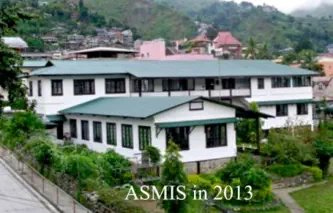
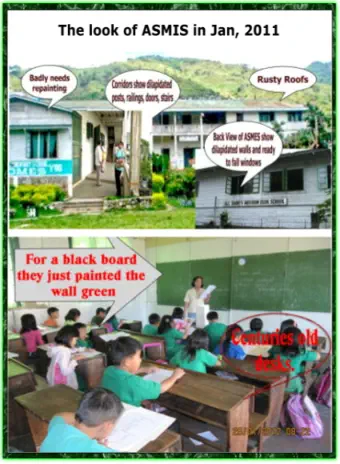
Contd. on dream curriculum
IV. The New ASMIS Philosophy of Education
and Strategic Plan.
Like
its
sister
church
institutions,
ASMIS
which
once
enjoyed
the
reputation
of
being
one
of
the
topnotch
elementary
schools
in
the
Philippine
Cordilleras,
was
reduced
to
a
struggling
mission
school
with
meager
resources,
performing
under
par
in
nationalized
standardized
tests,
with
an
apathetic
faculty
that
remained
stagnant
in
traditional
teaching
practices
and
a
series
of
administrators
who
could
not
progress
beyond
the
status
quo.
What
remained,
and
what
kept
the
school
barely
afloat
for
more
than
fifteen
years,
were
the
loyal
alumni
who
credited
the
school
for
their
success in professional and personal endeavors.
So
what
was
done
since
2011
when
the
school
was
reincorporated?
First
and
foremost,
the
school
departed
from
its
tradition
view
of
what
education
should
be.
The
school
community
-
faculty,
staff,
parents,
trustees,
and
supporters
-
embraced
the
concept
of
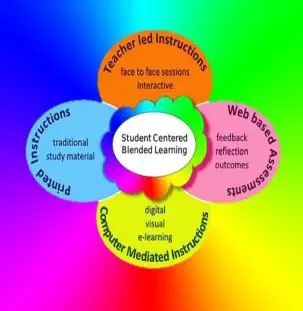
student-
centeredness,
which
governs
all
components
of
education,
ranging
from
instructional
methodology,
curriculum,
and
teaching
resources,
to
infrastructure
and
finance.
Its
core
belief
is
that,
since
every
students
is
unique,
instruction
must
be
individualized
as
much
as
possible
to
meet
the
needs
of
individuals
as
opposed
to
focusing
on
the
needs
of
the
majority
or
pandering merely to the gifted and talented.
Currently,
the
school
and
the
church
have
joined
together
in
formulating
a
more
effective
and
relevant
student-centered
curriculum,
particularly
in
the
realm
of
Christian
Values
Education
and
knowledge
application
versus
rote
memorization.
For
the
past
three
years,
during
summer
break
and
after
school,
the
faculty
and
staff
have
undergaone
training
in
the
K-12
Curriculum,
Student-Centered
Instructional
Strategies
and
Assessment,
and
Child-Centered
Nurturance, Discipline, and Emotional Development.
As
to
infrastructure,
most
of
the
learning
spaces
have
been
renovated
into
modern
student-friendly
classrooms,
made
posssible
by
donations
from
alumni,
individual
benefactors,
and
sister
institutions
like
Trinity
University
of
Asia.
Parents
have
rallied
to
support
increaes
in
tuition
and
purchases
of
the
latest
K-12
textbooks.
In
spite
of
no
tuition
subsidies
from
the
government,
the
school
was
able
to
make
a
modest
net
profit
that
was
plowed
back
into
the
school
for
maintenance.
Enrollment
figures
have
increased
to
345, up from the lowest figure three yers ago of 290.







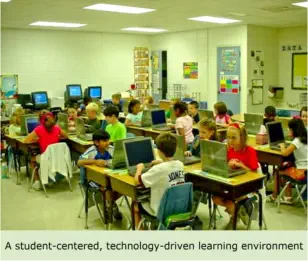
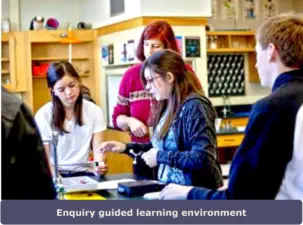
Contd. on
VI. The Need for Technology
ASMIS Dream Curriculum
- In the light of an ever growing competitive
technology-driven global economy -
Several
learning
approaches
have
emerged
in
response
to
the
quest
of
governments
and
industries
obsessed
for
a
competitive
edge
in
the
global
market
of
goods
services
and
ideas.
Among
the
more
popular
we
read
about
are
the
student-centered
learning
approach,
learning
by
inquiry,
progressive
method
and
a
blend
of
the
teacher-centered
and
student-centered
learning
approaches.
ASMIS
and
the
Philippines’
K-12
program
adopted the student-centered learning approach.
Viewed
in
the
context
of
a
nation’s
or
industry’s
economic
standpoint,
these
learning
approaches
seek
to
foster
the
factor-determinants
of
the
competitive
edge
equation. These include the following:
1.
Innate
talents
of
the
learner/student.
Students
are
endowed
with
different
talents.
Some
are
good
in
math
and
science;
some
are
good
in
music
and
the
arts;
some
are
good
in
law.
Students/learners
who
are
guided
to
develop
their
innate
talents
to
the
greatest
extent
possible
are
most
likely
to
have
greater
impact
in
an
industry’s,
government
‘s
or
nation’s
quest
for
a
competitive
edge
in
the
global
market
place
of
goods,
services and ideas.
2.
Innovative.
Innovations
can
keep
an
industry,
government,
or
nation
ahead
of
competitors.
That
is
why
innovative
individuals
are
prime
targets
of
manpower
resources
development
and
recruitment
programs.
3.
Results
Oriented.
Knowledge
accumulation
is
good;
but
knowlege
application
is
better.
It
is
the
application
of
knowledge
that
generates
and/or
improve
a
good
or
service.
4.
Team
Player
or
Collaborative.
Majority
of
goods
and
services
are
the
product
of
several
individuals,
a
team.
The
better
the
team
play,
the
better
are
the
chances of out-competing competitiors.
5.
Digitized
Communication
Skills
.
Computers,
digital
communications
and
related
technology
can
make
work
environments
and
procedures
faster,
safer
and more economical.
6.
Sensitive
to
Cultural,
Religious
and
Environ-
mental
Concerns.
Mega
million
projects
have
been
torpedoed
by
insensitivity
to
cultural
practices,
religious
beliefs
or
environmental
concerns.
Thus,
cultural
practices,
religious
beliefs
and
environmental
concerns
are
integral
components
in
feasibility
project
studies
or
cost-benefit analysis.
7.
Values
Formation.
Corruption
whether
in
govern-
ment
or
the
private
sector
is
a
deterrent
to
the
efficient
use
of
the
factors
of
production.
Many
times
we
have
seen
the
cost
of
a
project
blown
to
uneconomical
proportions
by
greedy
individuals.
These
individuals
have
become
callouse
to
universal
values
such
as:
“Thou
shall
not
steal”;
“Do
not
do
unto
others
what
you
don’t
want
others
do
unto
you”.
The
best
hope
of
regaining and or strengthening values are the youth.
8.
Love
of
country
or
ethnic
roots.
Love
of
country
or
ethnic
roots
can
inspire
a
people
to
produce
and
defend
what
is
right
for
themselves.
Unpatriotic
individuals
are
easy
prey
for
subjugation.
One
who
has
no
pride
for
his
people
will
likely
hide
in
the
shadows
and not join in efforts to improve their plight.
It
is
our
dream
that
ASMIS
will
soon
be
equipped
with
the
faculty
training
and
facilities
for
an
honest-to-
goodness
implementation
of
the
student-centered
learning approach.









the
various
academic
levels
of
students
in
the
classroom
by
assigning
an
initial
pre-
assessment
and
developing
tailor-made
activities to improve areas of weakness.
Transparency
:
Student
use
of
technology
can
make
the
thinking
and
problem-solving
process
more
transparent
to
the
teacher.
Digital
files
can
provide
documentation
of
the
processes
the
student
has
engaged
in
to
solve
problems.
It
is
often
easier
to
store
and
retrieve
these
files
electronically
than
on
paper.
Screen-monitoring
software
allows
teachers
to
observe
students
in
the
process
of
classwork.
Efficiency
:
Using
technology
can
reduce
the
workload
on
the
teacher
for
mundane
tasks
such
as
organization
and
distribution
of
electronic
learning
materials,
grading
of
multiple choice questions.
Cooperative
Grouping
and
Collaboration
:
Educators
frequently
utilize
cooperative
grouping
strategies
and
technology
integration
at
the
same
time
since
technology
is
very
conducive
to
group
work,
team
problem
solving,
etc.
Having
students
work
in
partnerships
or
small
groups
with
a
computer
based
activity
as
a
guide
allows
students
to
work
collaboratively
to
complete
a
technology-
based
activity.
Using
technology
allows
for
the
free
exchange
of
information.
The
widespread
use
of
compatible
text,
presentation,
and
image
software
allows
information
to
be
exchanged more easily than ever before.
Archiving
:
Technology
allows
teachers
to
more
efficently
save
and
document
student
work
for
archival
purposes.
Whether
it
be
students
working
on
a
paper
that
is
saved
under
their
name
or
scanning
in
classroom
worksheets
that
identify
where
a
student
is
in
their
learning
at
a
set
point
of
time,
technology
gives
the
power
to
save
information
in
ways
that
are
impossible
through
traditional
means.
This
leads
to
several
advantages
like
tracking
student
progress
over
time
or
looking
back
to
see
what
areas
need
improvement.
Computers
provide
easy
storage
and
access
to
a
student's
accumulating
portfolio
of
work.
By
viewing
previous
work,
students
can
better
gauge
their
own
progress
and
avoid
repeating
tasks
already accomplished.
Preparation
for
College
&
Career
:
With
computers
and
various
forms
of
technology
moving
more
prominently
into
the
mainstream
of
typical
life
and
business,
it
is
important
to
expose
our
students
to
different
types
of
technology.
Gaining
experience
in
word
processing,
various
software
programs,
internet
research,
etc.
are
essential
educational
needs
for
students
to
become
successful
in
the
workplace.
Using
technology
allows
for
a
smooth
transition
from
school
to
work
and
school
to
college.
Technology
is
used
everywhere
-
in
math,
science,
engineering,
transportation,
manufacturing,
and
every
business
application
you
can
think
of.
From
sales
transactions
and
inventory
control,
to
e-
commerce,
the
uses
for
technology
are
limitless. .
Problem-Solving
and
Project-Based
Learning
:
Developing
deep
competency
using
the
problem
solving
environment
provided
by
the
computer.
Technology
helps
promote
a
positive
shift
toward
more
project
based,
hands
on
learning,
away
from
lecture
based
learning.
Lecture
based
learning
will
not,
and
should
not,
disappear.
However,
the
information
manipulation
environment
provided
by
one-to-one
technology
allows
teachers to reduce their reliance on lecturing.
Source of Information:
http://schoolcomputing.wikia.com/wiki/Rationa
le_for_Technology_in_Education
Contd. on VII. The Need for a Science Lab.
VI. The Need for Technology
So
what
is
the
school’s
immediate
need?
In
order
to
deliver
the
new
curriculum
and
deal
with
student
centeredness
in
instruction,
the
school’s
current
priority
is
a
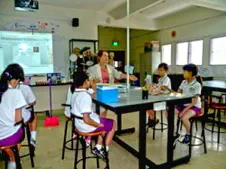
computer
laboratory,
not
only
for
student
instructions
in
technology,
but
also
for
the
administration
and
faculty.
Currently,
all
the
school
records
are
stored
on
two
computers
assigned
to
the
principal
and
the
registrar.
As
the
school
only
owns
one
working
computer,
it
has
to
rely
on
computers
personally
owned
by
faculty
and
staff.
Our
proposal
for
a
computer
lab
includes
30
computers
for
faculty
and
student
use
and
a
central
server
to
create
a
school
network
for
easy
and
reliable
communication
and
storage
of
student
data,
10
flat
screen
TV
sets
(one
per
classroom)
to
show
instructional
DVDs,
and
two
laptops
to
act
as
a
mobile
server
for
instructional materials.
The
underlying
philosophy
of
the
K-12
program,
the
student
centered
learining
approach,
is
computer
and
related
technology
driven.
Best
method
teaching
practices
as
well
as
specialized
lessons
(i.
e.,
for
slow
learners
and
handicapped
learners)
are
transmitted
mainly
through
DVDs,
CDs
and
digitized
communications.
The
inculcation
of
best
method
teaching
practices
and
specialized
lessons
will
greatly
be
enhanced
with
the
acquisition
of
the
computes
and
TV
sets
as
described above
Below
is
an
article,
copied
from
the
internet,
on
the
advantages
of
the
use
of
technology
in
schools.
- - - - - - - - - -
Why Use Technology?
Engagement
:
Using
technology
involves
students
in
the
learning
process.
Students
using
technology
become
active
in
the
learning
process
instead
of
passive
listeners.
One-to-
one
technology
enables
access,
manipulation,
and
presentation
of
information
and
knowledge.
It
can
be
a
very
creative
process,
especially
with
multimedia.
Using
technology
can
reduce
discipline
problems
if
students
are
more
interested
in
their
work.
Using
technology
allows
students
to
take
ownership
of
their
work.
When
students
are
empowered
to
find
their
own
answers,
the
learning
process
becomes
much
more
interesting.
Technology
allows
opportunities
for
multimedia
and
interactivity
that
are
impossible
with
more
traditional instructional techniques.
.
Empowerment
:
Using
technology
transforms
the
teacher
from
authority-expert
to
facilitator
when
the
students
are
guided
to
use
technology
to
find
answers
online.
Students
are
transformed
from
passive
recipients
of
the
teacher's
knowledge
to
active
participants
in
knowledge-seeking
and
knowledge-
construction.
Teachers
often
learn
new
technology programs along with students .
Access
to
Information
&
Commu-nication
:
The
internet
provides
access
to
an
incredible
array
of
information
sources,
media,
and
communications.
School-Home
Connections
:
Technology
can
offer
increased
accessibility
if
the
students
have
computer
and
internet
access
in
their
homes.
In
these
situations,
assignments,
activities,
assessments,
multimedia,
etc.
can
be
provided
over
the
web
and
completed
anywhere,
providing
for
a
wider
range
of
instructional
opportunities
for
anytime
anywhere learning.
Differentiation
:
Technology
frequently
provides
greater
opportunities
for
differentiation
for
students.
Computers
targeted
at
multimedia
applications
showing
pictures,
sounds,
and
videos
are
conducive
to
the
learning
styles
of
various
learners.
Additionally,
several
software
programs
have
exercises
that
are
targeted
at
differentiating
to










VII. The Need for a Science Lab.
ASMIS
is
appealing
for
support
to
its
plan
of
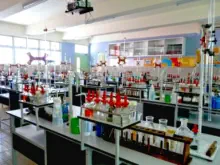
providing
a
science laboratory for its students.
The
rationale
for
a
school
science
laboratory
is
presented
below.
Why
schools
must
have
science
laboratory
equipment*
Science
is
different
from
any
other
subject
that
a
student
takes
up
in
school.
This
discipline
unlike
other
courses
affects
the
lives
of
each
and
every
person
in
several
ways.
From
the
local
weather
to
the
food
we
eat,
and
from
the
simple
electronic
devices
that
we
use
in
our
day
to
day
lives
to
the
complex
machines
and
systems,
science
is
everywhere.
Science
involves
seeing,
handling,
understanding
and
manipulating
of
real
objects
and
materials.
Teaching
science
therefore
requires
a
different
approach.
Schools
have
to
provide
opportunities
to
their
students
to
learn
the
various
methods
and
processes.
It
is
found
that
educational
institutes
that
combine
classroom
or
textbook
teaching
with
science
laboratory
experiments
are
able
to
derive
the
best
results
for
their
students.
Science
laboratory
equipment
and
experiments
aid
in
developing
scientific
learning
amongst
students,
and
in
cultivating
deeper and profound interest in the field.
This
is
because
the
knowledge
that
one
attains
in
classrooms
and
through
books
is
ineffectual
without
understanding
and
learning
the
methods
and
processes
behind
the
same.
Science
laboratory
equipment
allows
students
to
utilize
the
data
gathered
from
the
books,
as
well
from
the
material
world,
for
developing
pragmatic
logic
and
rationale.
Students
are
made
to
use
the
various
tools
and
experiment
with
different
techniques
to
improve
their overall science literacy.
Besides
offering
the
hands-on
experience,
science
laboratory
equipment
teaches
students
how
to
make
a
scientific
argument.
Conducting
experiments,
reviewing
them
closely,
developing
logical
reasoning,
and
responding
to
analytical
comments,
are
some
of
the
valuable
skills
that
help
in
preparing
the
next
generation
of
scientists,
engineers, and medical professionals.
School
science
lab
supplies
play
an
important
role
in
the
advances
and
technologies
being
made
in
the
world.
Many
of
the
world
famous
scientists
and
researchers
develop
their
life
long
interest
in
science
in
their
school
science
lab
only
where
they
conduct
their
first
science
lab
experiments.
Schools
must
therefore
invest
in
up-to-date
and
highly
advanced
science
laboratory
equipment
so
as
to
give
birth
to
highly
skilled
and
competent
scientific
and
technological
labor
force
and
to
assure
the
country
of
a
great
future
in
the
field
of
medical
sciences
and
technological developments.
*Source of information:
http://www.sciencefirst.com/advanced-science-laboratory-
equipment.html








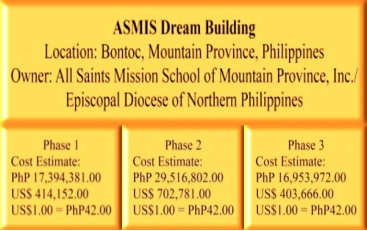
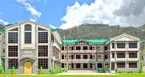
THE ASMIS DREAM BUILDING
The
ASMIS
dream
school
building
consists
of
a
right
wing
addition
to
the
main
building;
renovation
of
the
main
building;
and
renovation
of
the
left
wing
building to add an auditorium.
The
plan
is
to
add
classrooms
to
accommodate
the
new
high
school
department
and
kindergarten
departments
of
the
school;
to
fix
structural
defects
of
the
decades
old,
dilapidated
school
builing;
and
to
introduce
technological
innovations
to
meet
the
demands
of
its
student-centered
and
technology
driven curriculum.
Construction
schedule
is
divided
in
three
phases
and
made
contingent
on
the
results
of
fund-raising
efforts
by
the
ASMIS
Board
of
Trustees,
alumni
and
friends.
We
are
appealing
for
you
charitable
donations
to
the
ASMIS
Dream
Building
Fund.
Please
go
to
“Projects”
to
read
more
about
our
fund-raising
efforts.
Dream Funding Sources
1.
Dr.
Dennis
Faustino.
headmaster
of
ASMIS
is
donating
a
3
hectare
property
of
his
to
the
Episcopal
Diocese
of
Northern
Philippines
with
the
instruction
that
the
property
be
sold
to
generate
some
funds
for
the
1st
phase
of
the
ASMIS
Dream
Building.
2.
Mr.
Sherwyn
Laus,
a
member
of
the
ASMIS
Board
of
trustees
promised
to
donate
some
raffle
prizes
(a
car
/
motor
cycle)
to
help
generate
funds
for the 1st phase of the ASMIS Dream Building.
3.
Mana
from
heaven.
We
believe
in
the
power
of
prayer.
And
so
it
is
our
collective
prayer
that
some
kind
hearted
invidividuals,
corporations,
churches,
schools
and
other
institutional
donors
share
a
little
of
their
charitable
donation
budgets
towards
the
realizatiion
of
our
dream.
All
we
need
to
do
is
let
them know about our ASMIS dream.
It
is
in
that
light
that
we
have
created
this
website
to
announce
our
dream
to
the
world
with
the
hope
that
the
biblical
prophesy
“Seek
and
ye
shall
find;
knock
and
it
shall
be
open
unto
you”
will
come
true
for
the
school
kids
of
All
Saints
Mission
of
Mountain
Province, Inc..
We,
the
alumni
and
friends
of
All
Saints
Mission
Elementary
School,
have
scheduled
our
1st
ever
world-wide
conference
in
March
6-8,
2015
in
Alhambra,
California
at
the
Holy
Trinity
and
St.
Benedict
Church,
to
further
give
impetus
to
our
collective dream.
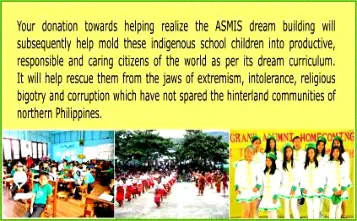










Under construction
VI. ASMIS, a model and training venue for the K-12 program.
Situated
in
Bontoc,
the
capital
town
of
Mountain
Province,and
headed
by
an
acknowledged
guru
of
the
student-centered
learning
approach
as
well
as
one
of
the
architects
of
the
K-12
progra,
ASMIS,
like
St.
Mary’s
School
of
Sagada,
could
be
a
model
and
training
venue
for
the
K-12
program
not
only
for
the
Mountain
Province
School
District
but
for
the
entire
Cordillera
Administrative
Region
(CAR).
ASMIS
and
SMSS
have
already
been
utilized
by
Dr.
Faustino
as
venues
for
workshops
and
seminars
related
to
K-12
best
method
teaching
methodologies
and
school
management.
ASMIS’s
continuing
role
as
a
training
venue
is
only
hampered
by
the
absence
of
sufficient
computer
and
related
techonology.
No
doubt
Dr.
Faustino’s
request
for
computer
and
related
technology
support
is,
likewise, geared towards realizing this objective.
1.
ASMIS Dream Building
2.
Computer Lab Project
3.
Science Laboratory
4.
Endowment Fund Project
5
.
Scholarship Project
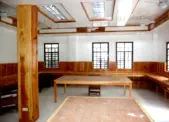


There
is
already
a
computer
room
built
from
fund-raising
efforts
of
ASMESAF-NA.
However,
Computers
are
needed
to
complete
the
project.
Estimated
cost
for
new
computers
and
related technology is PhP1,000,000.00 or US$24,000.00
ASMIS
Chairman
of
the
Board
Engr.
Rufino
Bomasang
organized
a
Golf
Tournament
in
Metro
Manila
last
February
27,
2015
which
raised
nearly
PhP
1
million
for
the
purchase
of
computers
for
the
computer
laboratory
and
TV
sets
for
classroom teaching and/or demonstration purposes.
Please read the rationale for
ASMIS Computers
Endowment
Fund
Drive
for
ASMIS
has
been
put
in
the
back
burner
to
addrees
first
the
repairs
of
the
dilapidated
school
building,
class
rooms
,
desks,
black
boards;
install
electric
lighting
and
fans;
construct
a
computer
lab;
as
well
as
renovate / repair the kindergarten rooms.
Alumni
and
friends
are
planning
to
launch
an
endowment
fund
drive
with
an
initial
target
of
PhP10
million
[about
US$239,000]
over
the
next
five
years.
Donations
towards
the
ASMIS endowment fund are encouraged.
The
school
has
only
about
PhP2
million
in
endowment
funds
as of May 31, 2014.
Dream funding sources:
1
.
Sale
of
3
hectare
property
donated
by
Dr.
Dennis
Faustino,
the
ASMIS Headmaster.
2
.
Raffle draw initiative of ASMIS BOT Sherwyn Laus.
3
.
ASMIS BOT Funding Networks
4
.
“Seek
and
ye
shall
find;
knock
and
it
shall
be
open
unto
you”
funding
initiative.
ASMESAF-NA
plans
on
trumpeting
the
ASMIS
dream
through
this
website;
project
proposals;
email,
mail
and
word-of-mouth
information
drive
to
alumni
and
friends
as
well
as
institutional
donors
such
as
churches,
schools,
corporations,
other
grants
and
aids
sources.
Hopefully
these
will
generate
results
proving
true
the
biblical
prophesy
“Seek
and
ye
shall
find;
knock
and
it
shall
be
open
unto
you
.
ASMIS Priority Projects and Fund Raising Efforts by the ASMIS
Board of Trustees, Episcopal Diocese of Norhtern Philippines,
the Parents-Teachers Association and
world-wide ASMES alumni and friends.
There
are
indigent
but
talented
students
who
would
love
to
enroll
at
All
Saints
Mission
School
of
Mountain
Province,
Inc.,
but
their
parents
could
not
afford
the
ASMIS
tuition
fees
of
from
PhP
8,000
to
PhP10,000
[US$200
to
US$250.00]
per
year
depending
on
the
grade
level.
Donations
for
scholarships
are
very much welcome

The
ASMIS
Headmaster,
Dr.
Dennis
Faustino
is
determined
to
provide
ASMIS
students
a
science
laboratory.
He
plans
to
build
this
alongside
the
computer
lab.
Estimated
cost
is
PhP
500,000.00
or
US$12,000.00
Dr.
Faustino
is
respectfully
suggesting
that
whatever
proceeds
from
fund-raising
efforts
by
alumni
and
friends
during
their
conference
on
March
5-8,
2015
in
Alahambra
California
be
allocated
to
the
science
lab
project.
That
conference
was
able
to
generate
over
US$12,000,
from
a
Golf
Tournament
for
the
ASMIS
Science
Laboratory.
Please read the rationale for an
ASMIS Science Laboratory.
Fund Raising Activities
So far ASMESAF-NA’s fund raising activites were as follows:
1.
General Solicitation
2.
Caroling
3.
Ayoweng concert
4.
Dinner Dance
5.
Golf Tournament 1
6.
Raffle Draw
7.
Golf Tournament 2
8.
Other Fund raisers
9.
Manila Golf Tournament
Fund Raising Activities
So far ASMESAF-NA’s fund raising activites were as follows:
1.
General Solicitation
2.
Caroling
3.
Ayoweng concert
4.
Dinner Dance
5.
Golf Tournament 1
6.
Raffle Draw
7.
Golf Tournament 2
8.
Other Fund raisers
9.
Manila Golf Tournament
I.
General
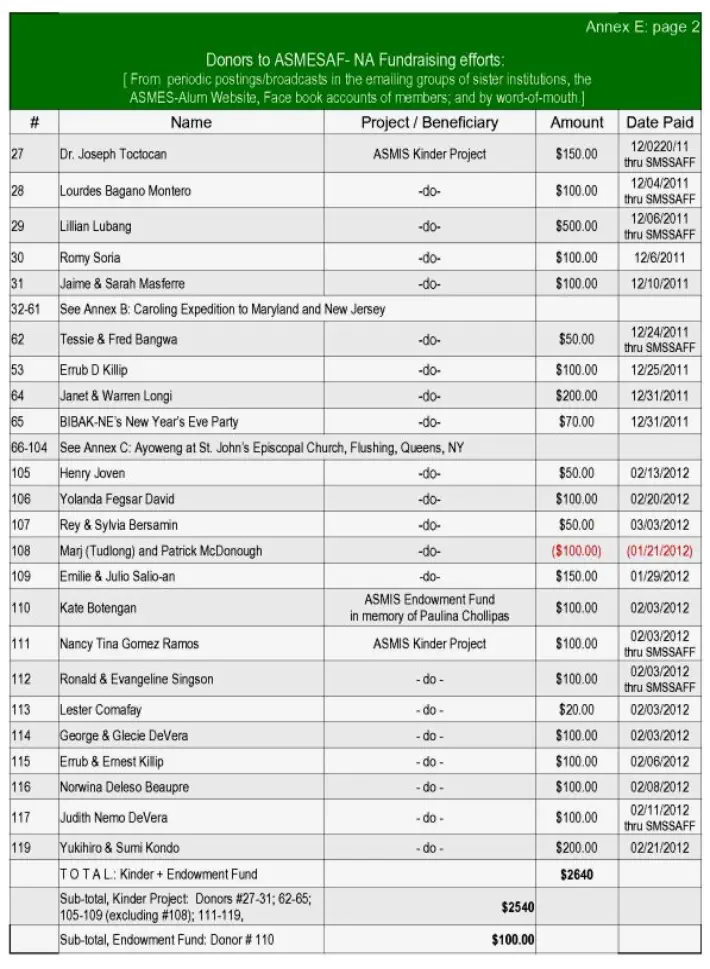
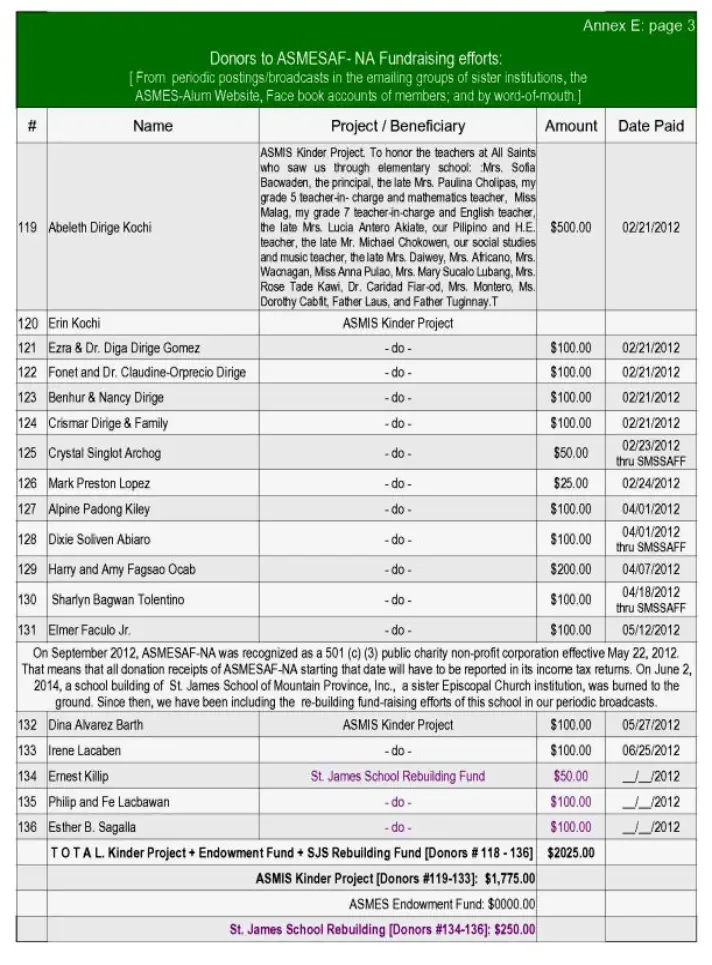
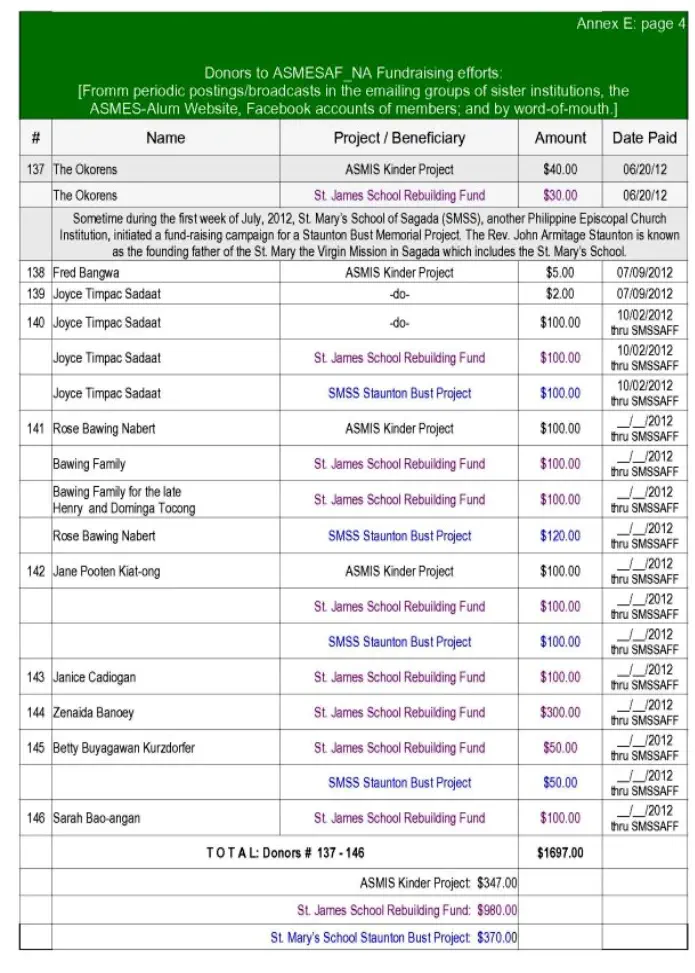
Solicitations.
These
are
periodic
ads/appeals
for
support
for
ASMIS
priority
projects
posted
in
the
emailing
groups
of
sister
institutions,
the
“http://asmesalum.webplus.net“
and
“http://
asmesaf-na.org
“
websites,
face
book
accounts
of
members,
as
well
as
by
word-of-
mouth.
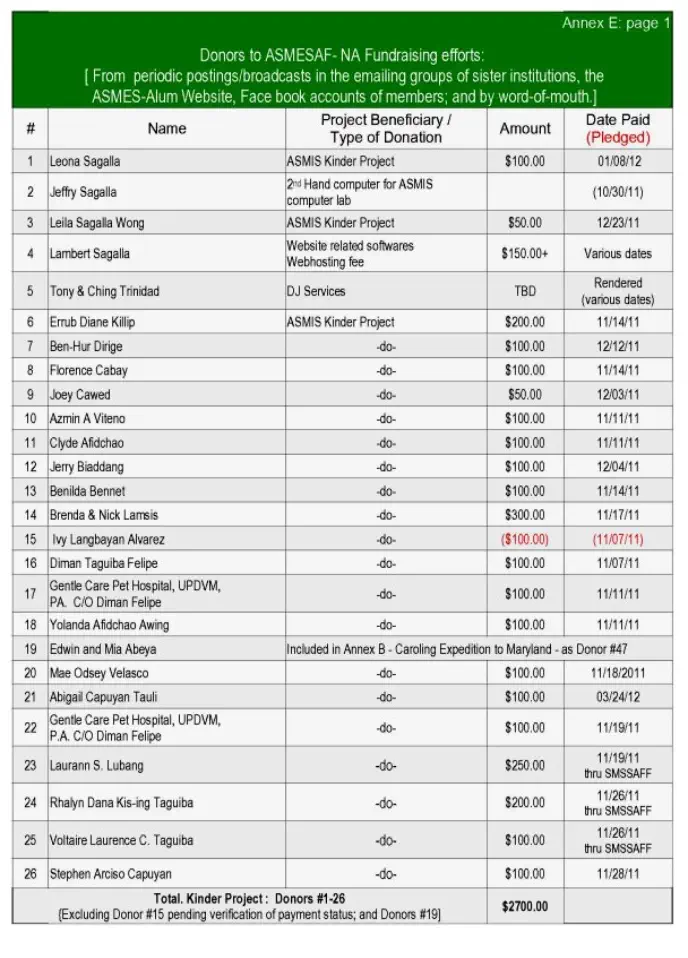









Fund Raising Activities
So far ASMESAF-NA’s fund raising activites were as follows:
1.
General Solicitation
2.
Caroling
3.
Ayoweng concert
4.
Dinner Dance
5.
Golf Tournament 1
6.
Raffle Draw
7.
Golf Tournament 2
8.
Other Fund raisers
9.
Manila Golf Tournament
Solicitation 2
Fund Raising Activities
So far ASMESAF-NA’s fund raising activites were as follows:
1.
General Solicitation
2.
Caroling
3.
Ayoweng concert
4.
Dinner Dance
5.
Golf Tournament 1
6.
Raffle Draw
7.
Golf Tournament 2
8.
Other Fund raisers
9.
Manila Golf Tournament
Solicitation 3
Fund Raising Activities
So far ASMESAF-NA’s fund raising activites were as follows:
1.
General Solicitation
2.
Caroling
3.
Ayoweng concert
4.
Dinner Dance
5.
Golf Tournament 1
6.
Raffle Draw
7.
Golf Tournament 2
8.
Other Fund raisers
9.
Manila Golf Tournament
Solicitation 4
Fund Raising Activities
So far ASMESAF-NA’s fund raising activites were as follows:
1.
General Solicitation
2.
Caroling
3.
Ayoweng concert
4.
Dinner Dance
5.
Golf Tournament 1
6.
Raffle Draw
7.
Golf Tournament 2
8.
Other Fund raisers
9.
Manila Golf Tournament
Solicitation 5
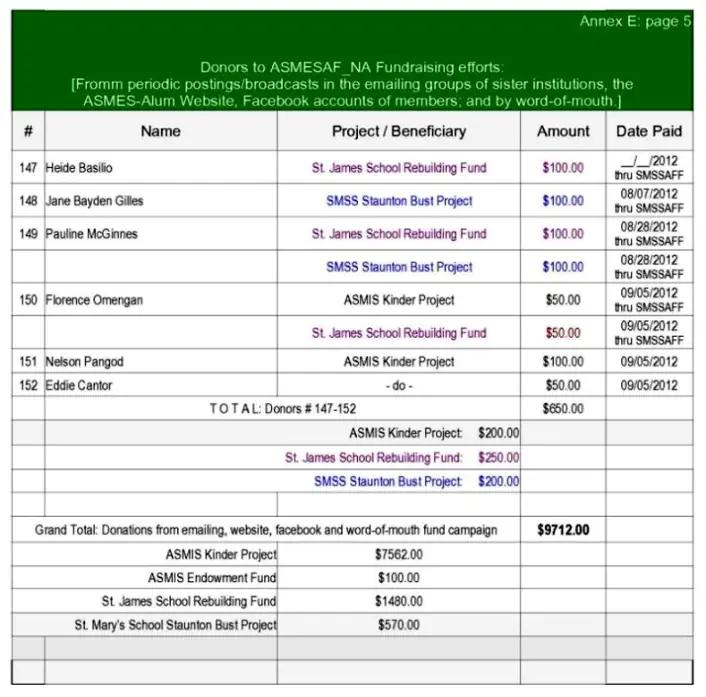
Note: I understand that funds not utilized in the kindergarten room rehabilitation were utilized
in the construction of the computer laboratory room.
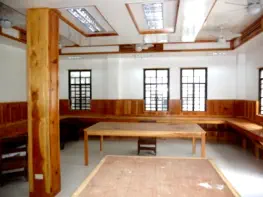
Computer Laboratory Room
Fund Raising Activities
So far ASMESAF-NA’s fund raising activites were as follows:
1.
General Solicitation
2.
Caroling
3.
Ayoweng concert
4.
Dinner Dance
5.
Golf Tournament 1
6.
Raffle Draw
7.
Golf Tournament 2
8.
Other Fund raisers
9.
Manila Golf Tournament
II.
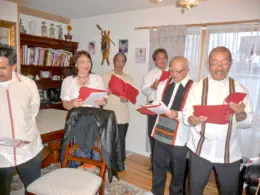
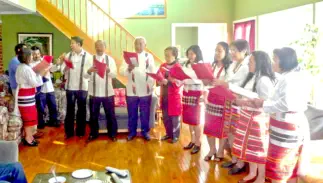
Caroling
Expedition.
These
were
caroling
activities
conducted
by
alumni
and
friends
of
All
Saints
Mission
School
of
Mountain
Province,
Inc
[ASMIS],
during
the
2011
Christmas
holidays,
to
raise
funds
for
the
rehabilitation
of
the
ASMIS
Kindergarten
room.
The
carolings
were
hosted
by
supportive
ASMIS
alumni
and
friends
from
the
New
Jersey
and
Maryland
area.
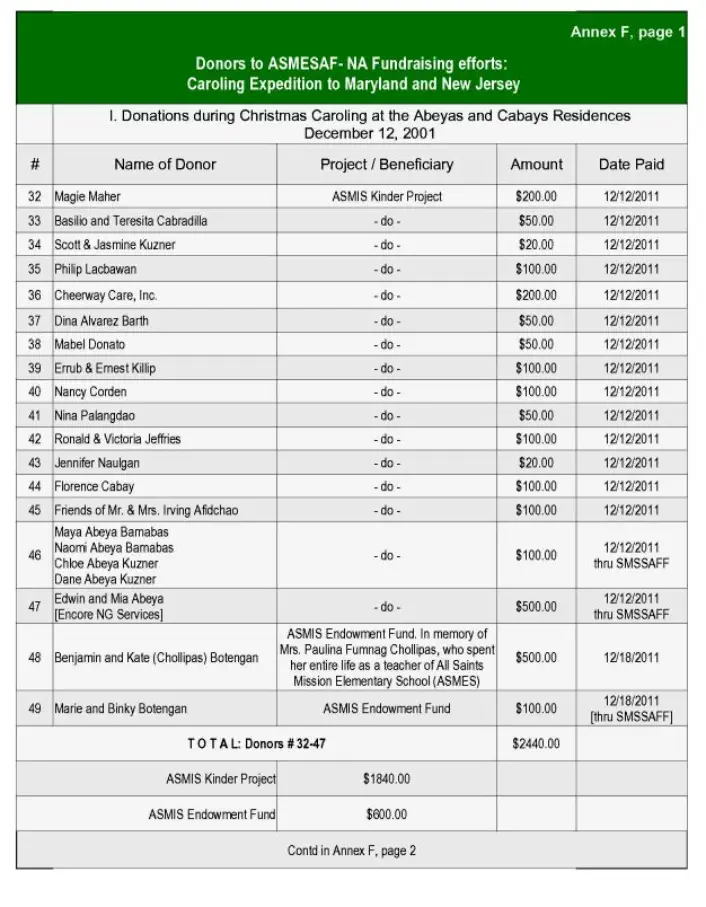
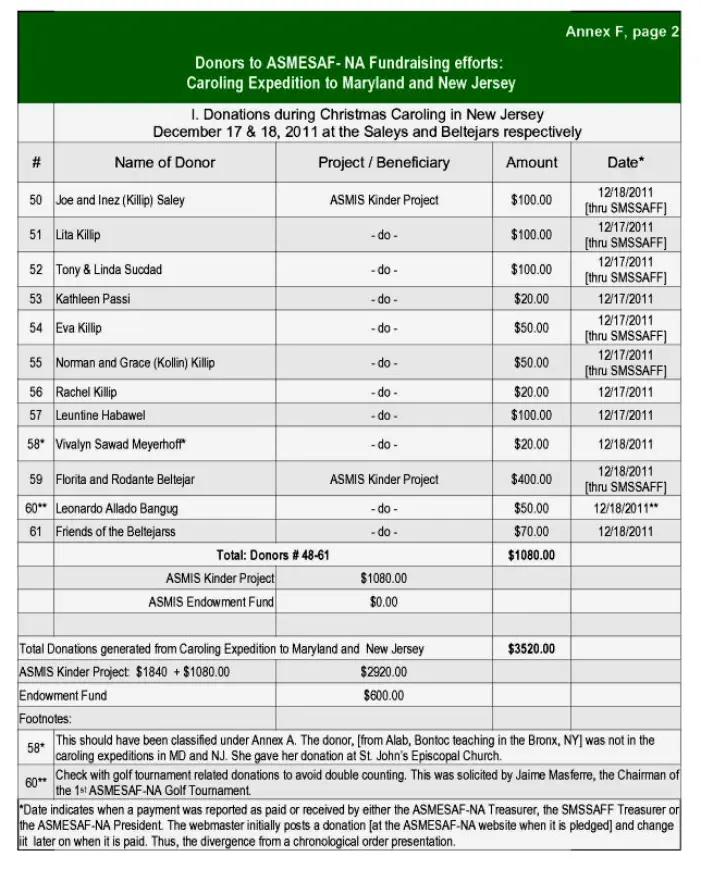
Some
$3,520.00
were
raised
from
the
caroling
expedition
of
which
$2,920.00
were
allocated
to
the
ASMIS
kindergarten room and $600.00 for the School’s endowment fund as per request of the donors.
Click
on
any
of
the
pictures
to
view
some
youtube
uploads
on
the
caroling
expedition.
Click
on
the navigation bars below to see the names of our generous donors.






Fund Raising Activities
So far ASMESAF-NA’s fund raising activites were as follows:
1.
General Solicitation
2.
Caroling
3.
Ayoweng concert
4.
Dinner Dance
5.
Golf Tournament 1
6.
Raffle Draw
7.
Golf Tournament 2
8.
Other Fund raisers
9.
Manila Golf Tournament
Caroling Expedition 1






Fund Raising Activities
So far ASMESAF-NA’s fund raising activites were as follows:
1.
General Solicitation
2.
Caroling
3.
Ayoweng concert
4.
Dinner Dance
5.
Golf Tournament 1
6.
Raffle Draw
7.
Golf Tournament 2
8.
Other Fund raisers
9.
Manila Golf Tournament
Caroling Expedition 2
Ayoweng
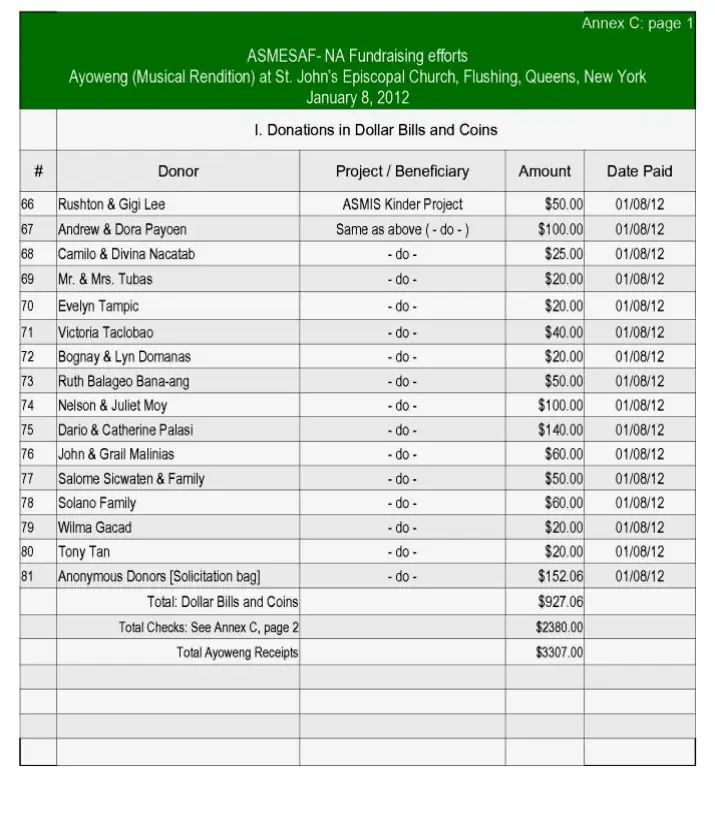
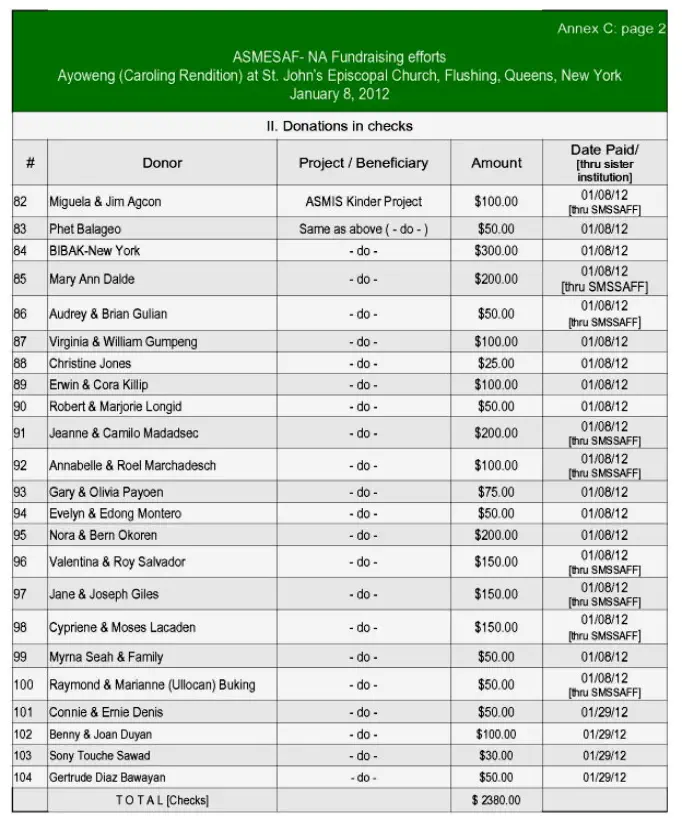
This was a sort of concert presentation by ASMIS Alumni and Friends at the St.
John’s Episcopal Church in Flushing, Queens, New York during the feast of the
Three Kings [February], 2012.
We were able to generate some $3,307.00 for the ASMIS kinder project from this
concert. Click on the YouTube upload links below to view some video clips on this
concert.

YouTube uploads:
Click on the navigation bars below to see the names of the generous donors.






Fund Raising Activities
So far ASMESAF-NA’s fund raising activites were as follows:
1.
General Solicitation
2.
Caroling
3.
Ayoweng concert
4.
Dinner Dance
5.
Golf Tournament 1
6.
Raffle Draw
7.
Golf Tournament 2
8.
Other Fund raisers
9.
Manila Golf Tournament
Ayoweng-Concert 1
Fund Raising Activities
So far ASMESAF-NA’s fund raising activites were as follows:
1.
General Solicitation
2.
Caroling
3.
Ayoweng concert
4.
Dinner Dance
5.
Golf Tournament 1
6.
Raffle Draw
7.
Golf Tournament 2
8.
Other Fund raisers
9.
Manila Golf Tournament
Ayoweng Concert 2
Fund Raising Activities
So far ASMESAF-NA’s fund raising activites were as follows:
1.
General Solicitation
2.
Caroling
3.
Ayoweng concert
4.
Dinner Dance
5.
Golf Tournament 1
6.
Raffle Draw
7.
Golf Tournament 2
8.
Other Fund raisers
9.
Manila Golf Tournament
Dinner Dance. The flyer below describes what this was all about.

See: Donations and Expenses to see how much was made from this dinner
dance and who the generous donors were. [Use your browser’s back button
to return to this website.]
Fund Raising Activities
So far ASMESAF-NA’s fund raising activites were as follows:
1.
General Solicitation
2.
Caroling
3.
Ayoweng concert
4.
Dinner Dance
5.
Golf Tournament 1
6.
Raffle Draw
7.
Golf Tournament 2
8.
Other Fund raisers
9.
Manila Golf Tournament
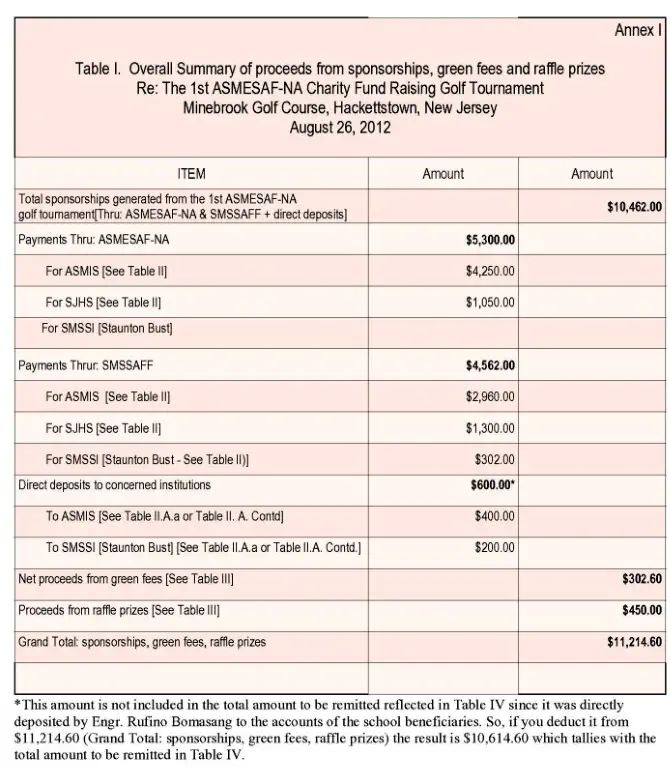
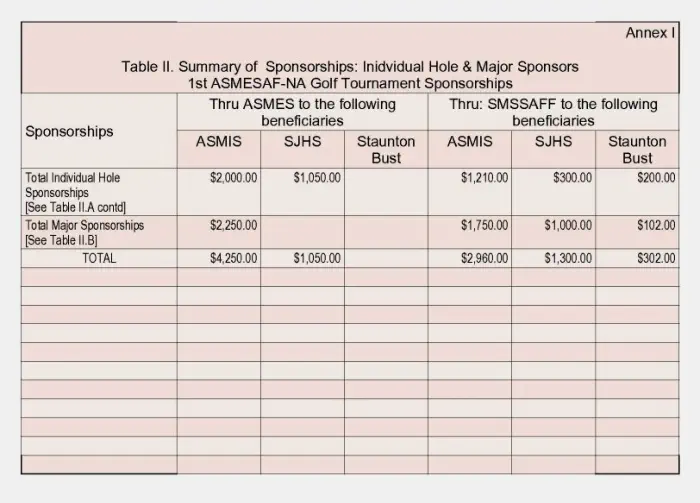
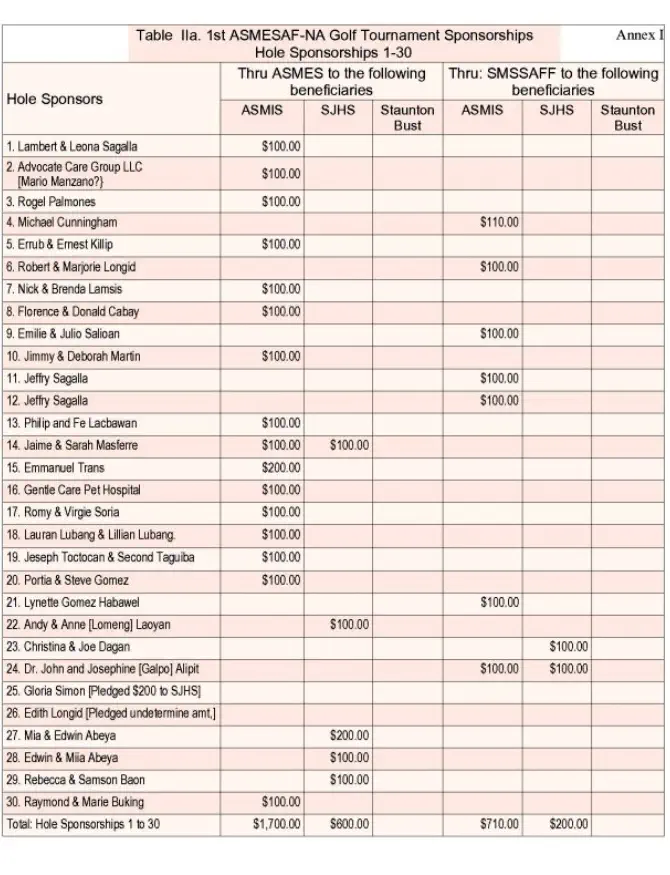
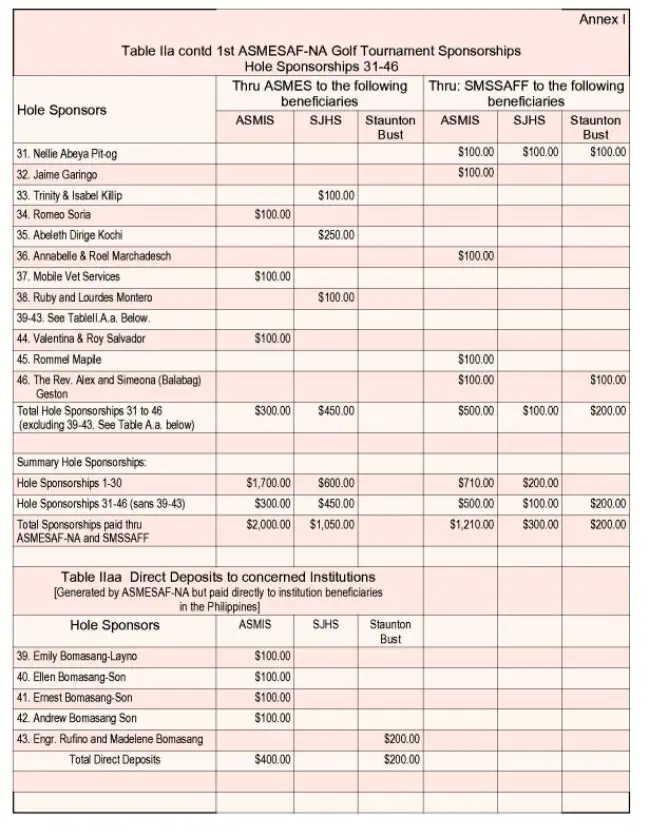
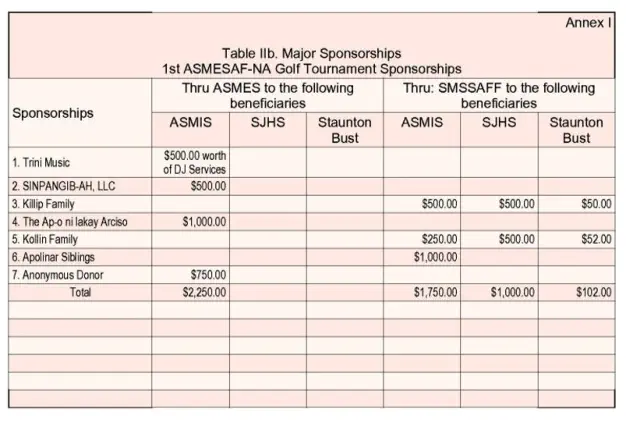
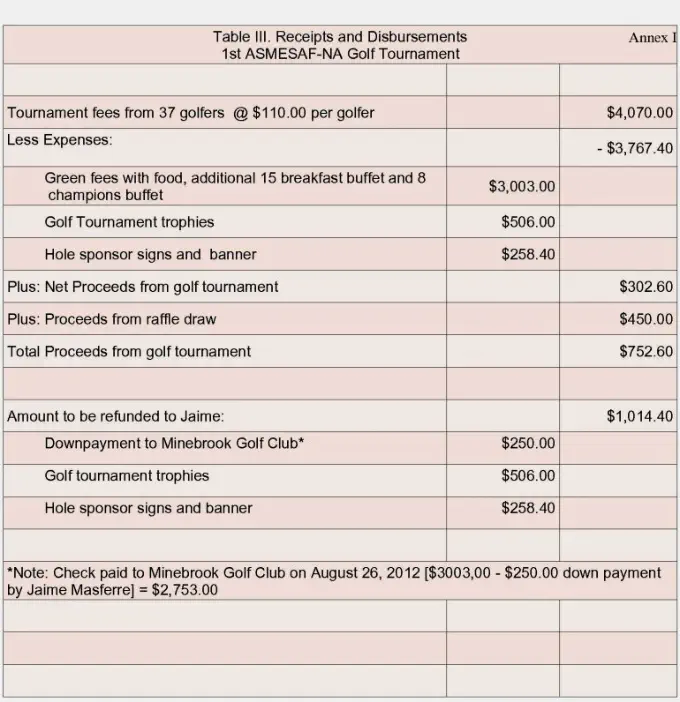
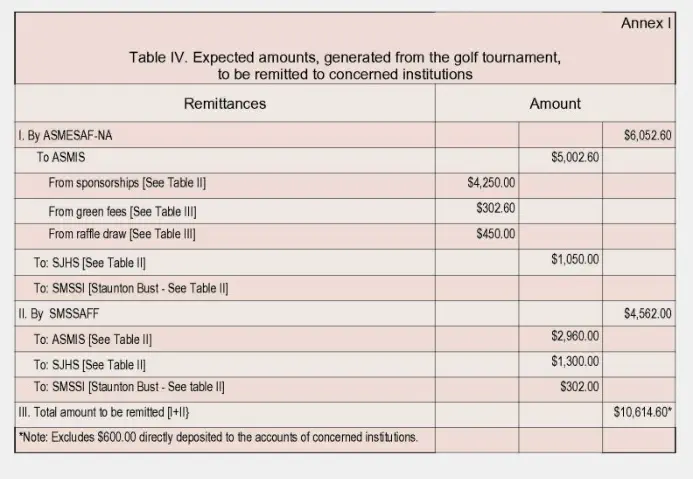
First ASMESAF-NA Golf Tournament

Note: You can aslo surf the details of the first ASMESAF-NA golf tournament through this link:
First ASMESAF-NA Golf Tournament
Thank you.
LBS
Browse
the
links
below
to
see
how
much
was
raised
from
this
golf
tournament,
the
generous
donors,
and
the lucky beneficiaries.
















Fund Raising Activities
So far ASMESAF-NA’s fund raising activites were as follows:
1.
General Solicitation
2.
Caroling
3.
Ayoweng concert
4.
Dinner Dance
5.
Golf Tournament 1
6.
Raffle Draw
7.
Golf Tournament 2
8.
Other Fund raisers
9.
Manila Golf Tournament
Table I


Fund Raising Activities
So far ASMESAF-NA’s fund raising activites were as follows:
1.
General Solicitation
2.
Caroling
3.
Ayoweng concert
4.
Dinner Dance
5.
Golf Tournament 1
6.
Raffle Draw
7.
Golf Tournament 2
8.
Other Fund raisers
9.
Manila Golf Tournament
Table II


Fund Raising Activities
So far ASMESAF-NA’s fund raising activites were as follows:
1.
General Solicitation
2.
Caroling
3.
Ayoweng concert
4.
Dinner Dance
5.
Golf Tournament 1
6.
Raffle Draw
7.
Golf Tournament 2
8.
Other Fund raisers
9.
Manila Golf Tournament
Table IIa


Fund Raising Activities
So far ASMESAF-NA’s fund raising activites were as follows:
1.
General Solicitation
2.
Caroling
3.
Ayoweng concert
4.
Dinner Dance
5.
Golf Tournament 1
6.
Raffle Draw
7.
Golf Tournament 2
8.
Other Fund raisers
9.
Manila Golf Tournament
Table IIa contd


Fund Raising Activities
So far ASMESAF-NA’s fund raising activites were as follows:
1.
General Solicitation
2.
Caroling
3.
Ayoweng concert
4.
Dinner Dance
5.
Golf Tournament 1
6.
Raffle Draw
7.
Golf Tournament 2
8.
Other Fund raisers
9.
Manila Golf Tournament
Table IIb


Fund Raising Activities
So far ASMESAF-NA’s fund raising activites were as follows:
1.
General Solicitation
2.
Caroling
3.
Ayoweng concert
4.
Dinner Dance
5.
Golf Tournament 1
6.
Raffle Draw
7.
Golf Tournament 2
8.
Other Fund raisers
9.
Manila Golf Tournament
Table III


Fund Raising Activities
So far ASMESAF-NA’s fund raising activites were as follows:
1.
General Solicitation
2.
Caroling
3.
Ayoweng concert
4.
Dinner Dance
5.
Golf Tournament 1
6.
Raffle Draw
7.
Golf Tournament 2
8.
Other Fund raisers
9.
Manila Golf Tournament
Table IV


Raffle Draw: April 28, 2013
This
raffle
draw
was
initiated
by
alumni
and
friend
of
All
Saints
Mission
Elementary
School
in
the
West
Coast
United
States
[ASMESA-West
Coast]
to
raise
funds
for
music
and
sports
equipment
for
All
Saints
Mission
School
of
Mountain
Province,
Inc.
[ASMIS].
Drawing
was
held
at
the
Holy
Trinity
St.
Benedict’s
Church
in
Alhambra,
California,
on
April
28,
2013.
They
were
able to raise a net income of $ 7,844.00, enough for their alma mater’s drum and lyre band.
The receipts and expenses as well as the raffle draw winners are presented below:












































Fund Raising Activities
So far ASMESAF-NA’s fund raising activites were as follows:
1.
General Solicitation
2.
Caroling
3.
Ayoweng concert
4.
Dinner Dance
5.
Golf Tournament 1
6.
Raffle Draw
7.
Golf Tournament 2
8.
Other Fund raisers
9.
Manila Golf Tournament




Fund Raising Activities
So far ASMESAF-NA’s fund raising activites were as follows:
1.
General Solicitation
2.
Caroling
3.
Ayoweng concert
4.
Dinner Dance
5.
Golf Tournament 1
6.
Raffle Draw
7.
Golf Tournament 2
8.
Other Fund raisers
9.
Manila Golf Tournament


Fund Raising Activities
So far ASMESAF-NA’s fund raising activites were as follows:
1.
General Solicitation
2.
Caroling
3.
Ayoweng concert
4.
Dinner Dance
5.
Golf Tournament 1
6.
Raffle Draw
7.
Golf Tournament 2
8.
Other Fund raisers
9.
Manila Golf Tournament


Fund Raising Activities
So far ASMESAF-NA’s fund raising activites were as follows:
1.
General Solicitation
2.
Caroling
3.
Ayoweng concert
4.
Dinner Dance
5.
Golf Tournament 1
6.
Raffle Draw
7.
Golf Tournament 2
8.
Other Fund raisers
9.
Manila Golf Tournament


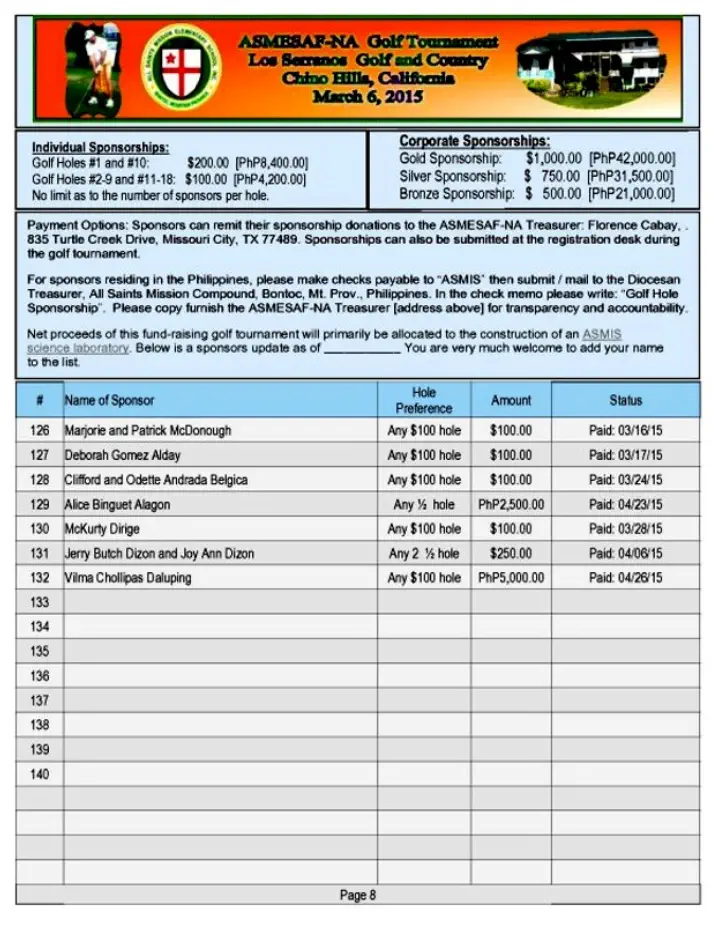
Fund Raising Activities
So far ASMESAF-NA’s fund raising activites were as follows:
1.
General Solicitation
2.
Caroling
3.
Ayoweng concert
4.
Dinner Dance
5.
Golf Tournament 1
6.
Raffle Draw
7.
Golf Tournament 2
8.
Other Fund raisers
9.
Manila Golf Tournament
Go to: Golf Tournament Page

Fund Raising Activities
So far ASMESAF-NA’s fund raising activites were as follows:
1.
General Solicitation
2.
Caroling
3.
Ayoweng concert
4.
Dinner Dance
5.
Golf Tournament 1
6.
Raffle Draw
7.
Golf Tournament 2
8.
Other Fund raisers
9.
Manila Golf Tournament
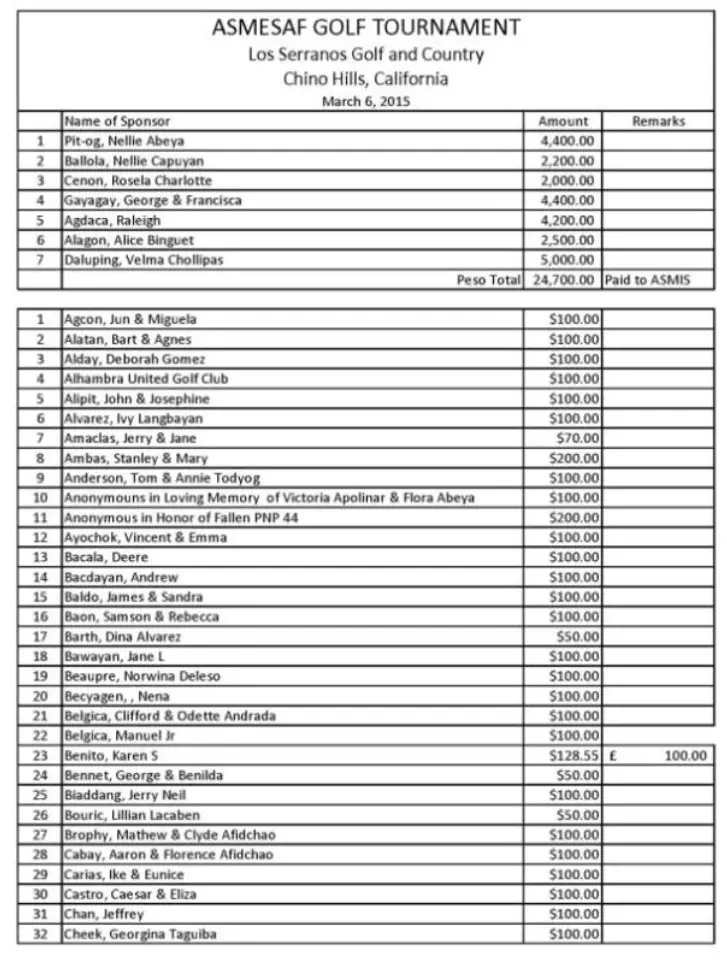


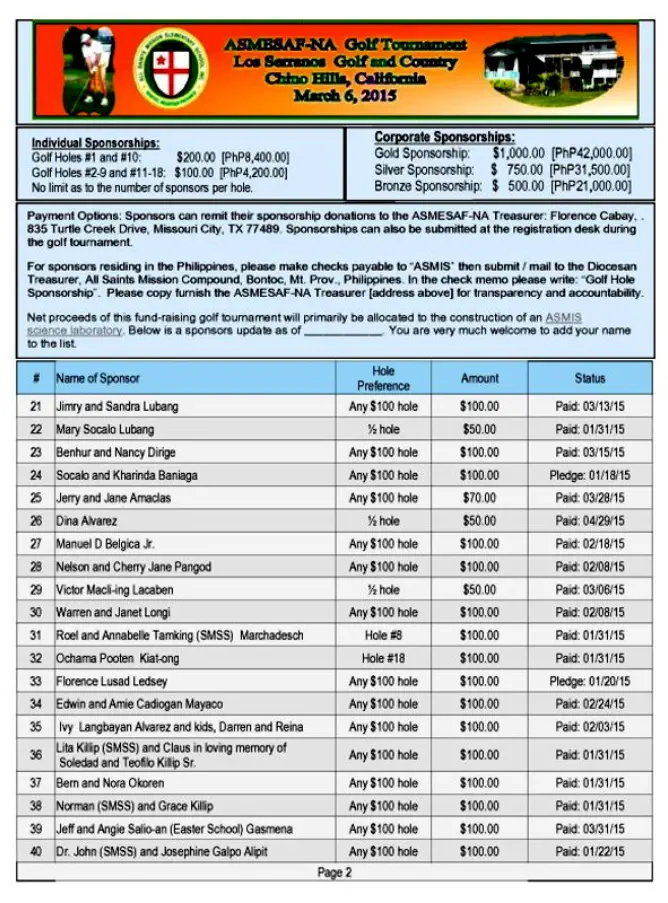
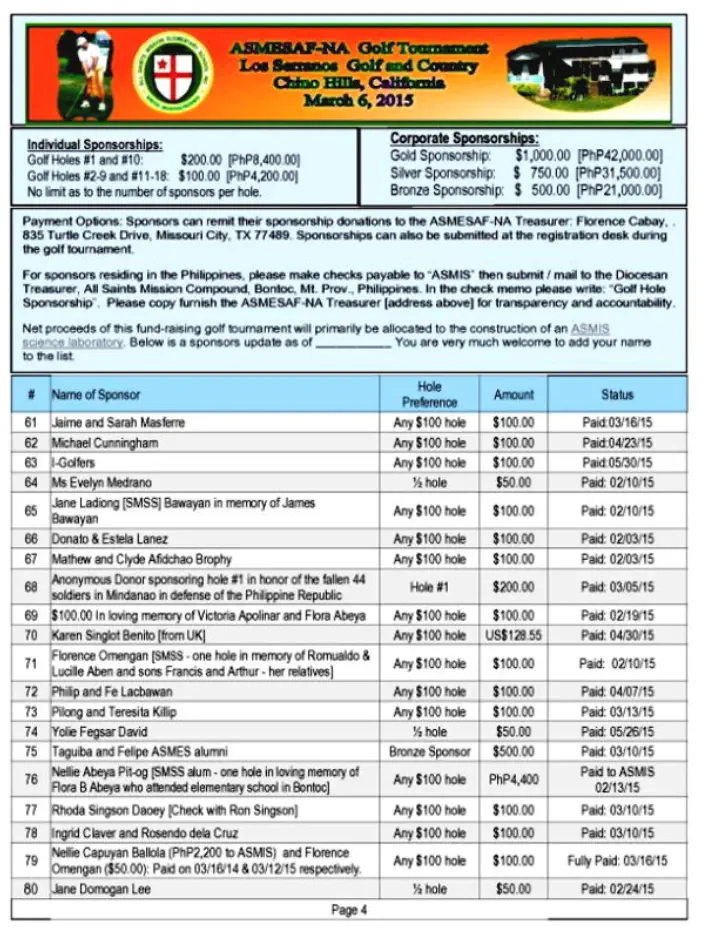
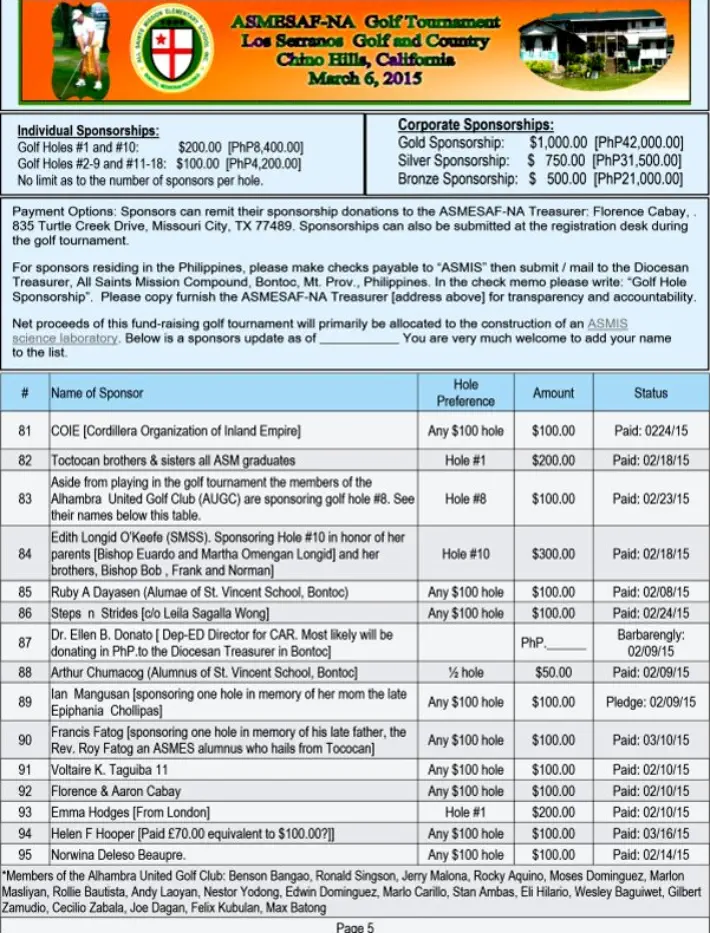
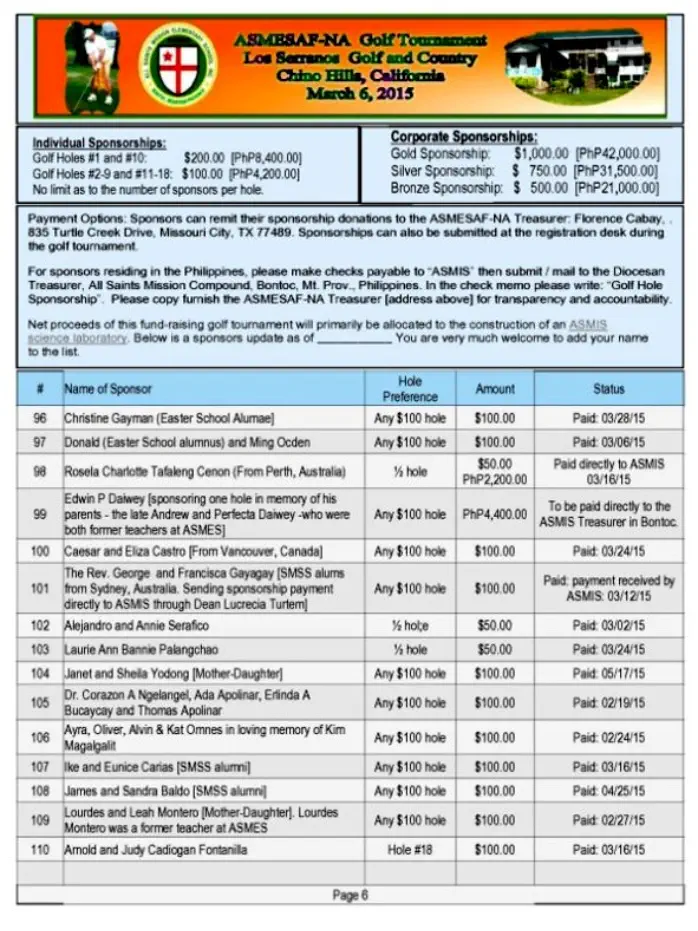
The Florence Cabay [ASMESAF-NA Treasurer] final report on the 2nd ASMESAF-NA golf tournament. It includes only
the names of sponsors who paid their pledges and lists them in alphabetical order except for sponsors/donors who paid
their pledges directly to the ASMIS Treasurer in Bontoc. It also includes remittances to ASMIS and expenses related
thereto [page 4]. The website list which is arranged according to when the sponsors made their pledges is maintained to
acknowledge all those who had the good intention of sponsoring although a few, for one reason or another, have yet to
make good their pledges. We thank them anyway and wish them well. LBS
Fund Raising Activities
So far ASMESAF-NA’s fund raising activites were as follows:
1.
General Solicitation
2.
Caroling
3.
Ayoweng concert
4.
Dinner Dance
5.
Golf Tournament 1
6.
Raffle Draw
7.
Golf Tournament 2
8.
Other Fund raisers
9.
Manila Golf Tournament
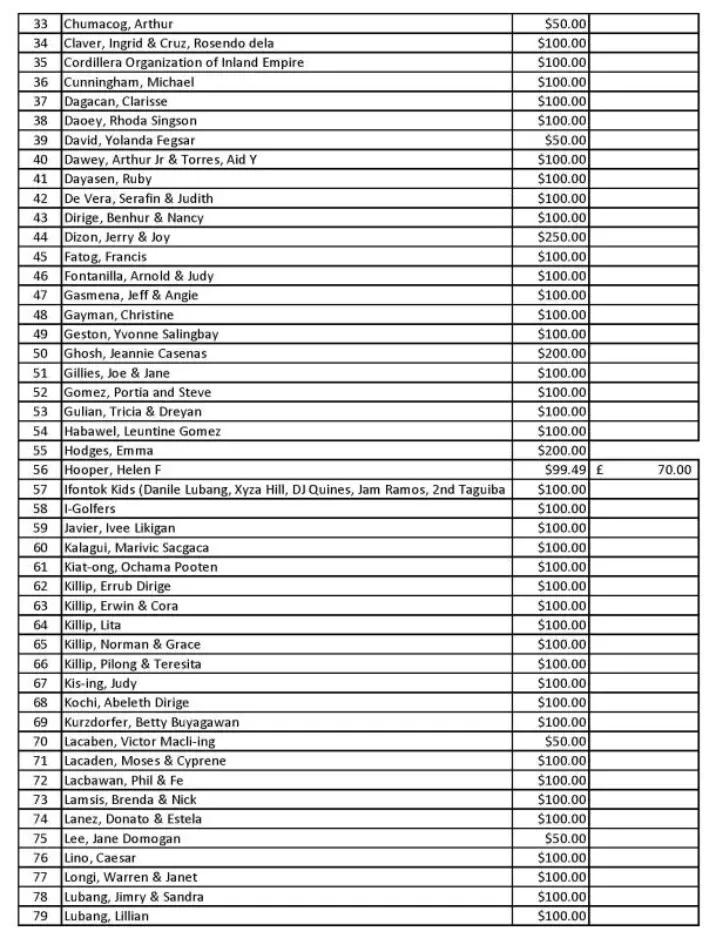
FC Report p2


Fund Raising Activities
So far ASMESAF-NA’s fund raising activites were as follows:
1.
General Solicitation
2.
Caroling
3.
Ayoweng concert
4.
Dinner Dance
5.
Golf Tournament 1
6.
Raffle Draw
7.
Golf Tournament 2
8.
Other Fund raisers
9.
Manila Golf Tournament
FC Report p3


Fund Raising Activities
So far ASMESAF-NA’s fund raising activites were as follows:
1.
General Solicitation
2.
Caroling
3.
Ayoweng concert
4.
Dinner Dance
5.
Golf Tournament 1
6.
Raffle Draw
7.
Golf Tournament 2
8.
Other Fund raisers
9.
Manila Golf Tournament
PS. The difference between the remaining balance [$6,424.63 and the remitted amount [$6,379.63] is
the wire transfer fee.
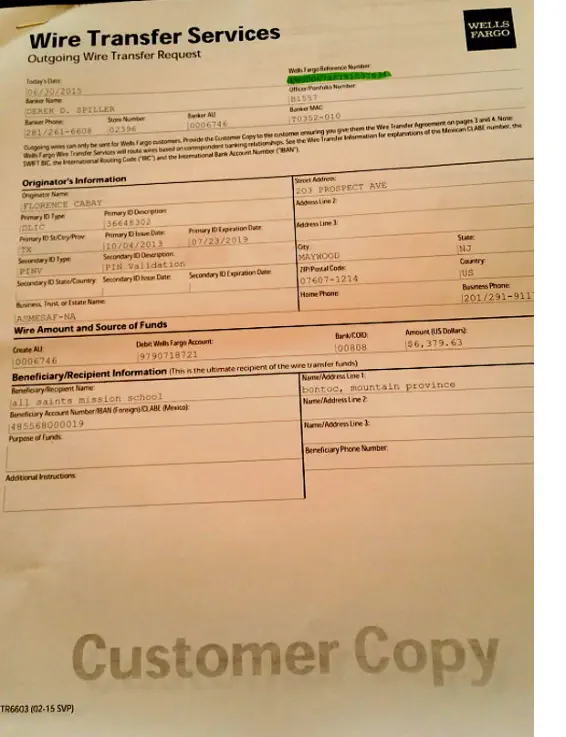
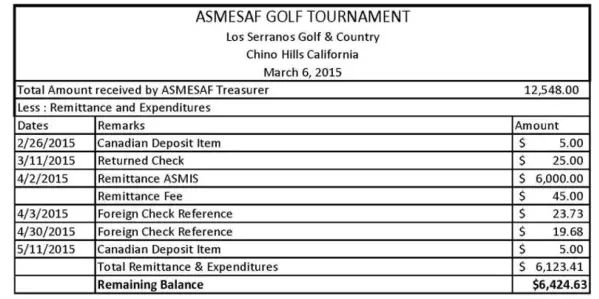
FC Report p4


Fund Raising Activities
So far ASMESAF-NA’s fund raising activites were as follows:
1.
General Solicitation
2.
Caroling
3.
Ayoweng concert
4.
Dinner Dance
5.
Golf Tournament 1
6.
Raffle Draw
7.
Golf Tournament 2
8.
Other Fund raisers
9.
Manila Golf Tournament

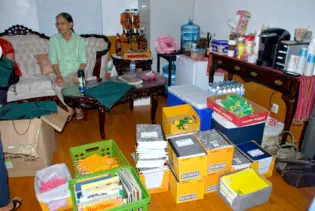
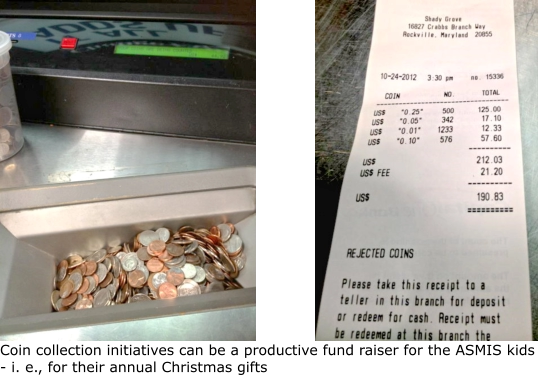

Coin Collection
T-Shirt Sales
Balikbayan boxes for ASMIS kids
![ASMIS Kids receiving their Christmas gifts from Santa Claus [acted by the school headmaster - Dr. Dennis Faustino].](index_htm_files/38809.webp)
Other Fund Raising Acttiviies.
Other fund raising activities undertaken by alumni and friends of All Saints Mission of Mountain
Province, Inc. in the UJSA include the annual Christmas gifts via balikbayan boxes to the ASMIS
kids; T-shirt sales and coin collection initiatives.

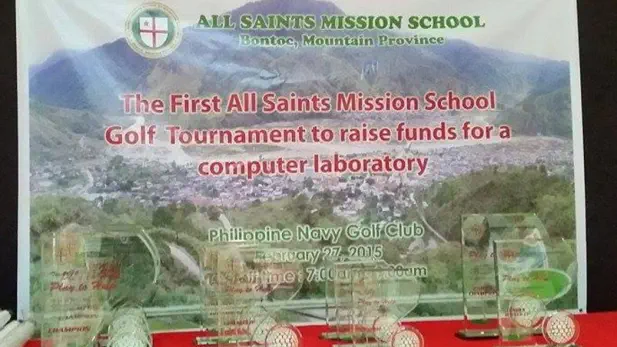
Browse
the
hereunder
links
to
see
the
names
of
those
who
sponsored
and/or
donated to this tournament:
Sponsors Update1
Sponsors Update 2
Sponsors Update 3
The
First
ASMIS
Manila
Golf
Tournament.
The
tournament,
held
at
the
Philippine
Navy
Club
on
February
27,
2015,
was
able
to
generate
948,500
Philippine
pesos,
equivalent
to
about
US$21,500.00,
for
the
purchase
of
computers
and
TV
sets
for
the
ASMIS
computer
laboratory
and classrooms.
ASMESAF-NA
had
nothing
to
do
with
this
tournament.
It
was
alomost
singlehandedly
initiated
and
managed
by
Engr.
Rufino
Bomasang,
the
Chairman
of
the
Board
of
Trustees
of
ASMIS.
The
results
of
the
tournament
are
reported
in
this
ASMESAF-NA
website
as
a
way
of
acknowledging
and
thanking
the
generours
sponsors/donors
of
the
tournament,
majority
of
who
are
non
ASMIS
alumni,
non-Episcopalians
and
non-Igorots.
May
He
From
Whom
All
Blessings
Flow
continue
to
shower you with HIS blessings.
Fund Raising Activities
So far ASMESAF-NA’s fund raising activites were as follows:
1.
General Solicitation
2.
Caroling
3.
Ayoweng concert
4.
Dinner Dance
5.
Golf Tournament 1
6.
Raffle Draw
7.
Golf Tournament 2
8.
Other Fund raisers
9.
Manila Golf Tournament

Fund Raising Activities
So far ASMESAF-NA’s fund raising activites were as follows:
1.
General Solicitation
2.
Caroling
3.
Ayoweng concert
4.
Dinner Dance
5.
Golf Tournament 1
6.
Raffle Draw
7.
Golf Tournament 2
8.
Other Fund raisers
9.
Manila Golf Tournament


Fund Raising Activities
So far ASMESAF-NA’s fund raising activites were as follows:
1.
General Solicitation
2.
Caroling
3.
Ayoweng concert
4.
Dinner Dance
5.
Golf Tournament 1
6.
Raffle Draw
7.
Golf Tournament 2
8.
Other Fund raisers
9.
Manila Golf Tournament


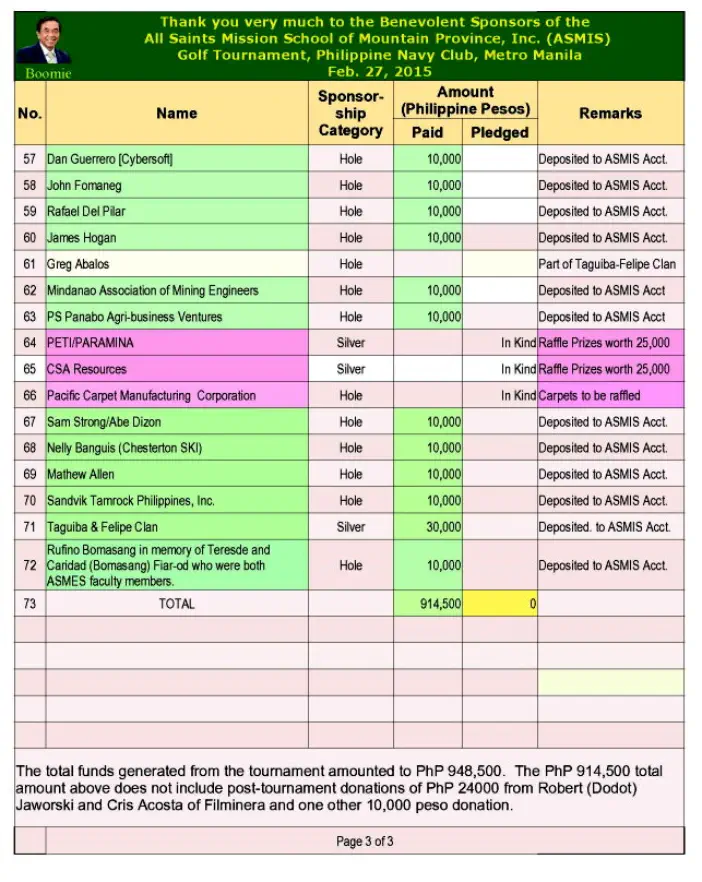
Fund Raising Activities
So far ASMESAF-NA’s fund raising activites were as follows:
1.
General Solicitation
2.
Caroling
3.
Ayoweng concert  4.
Dinner Dance
4.
Dinner Dance  5.
Golf Tournament
5.
Golf Tournament  1
6.
Raffle Draw
7.
Golf Tournament 2
8.
Other Fund raisers
9.
Manila Golf Tournament
1
6.
Raffle Draw
7.
Golf Tournament 2
8.
Other Fund raisers
9.
Manila Golf Tournament
4.
Dinner Dance
5.
Golf Tournament
1
6.
Raffle Draw
7.
Golf Tournament 2
8.
Other Fund raisers
9.
Manila Golf Tournament
Below
are
links
to
financial
statements
shared
by
Carole
Cofulan,
Treasurer
of
the
Episcopal
Diocese
of
Northern
Philippines,
showing
where
donations
to
ASMIS
have
been
spent.
Click
on
the
navigation
buttons
to view.
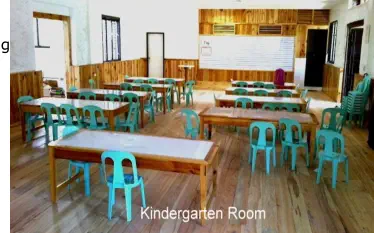
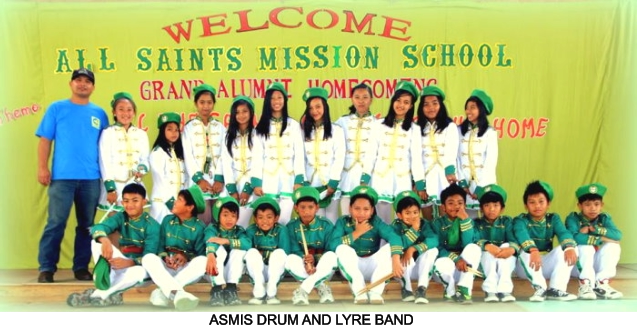
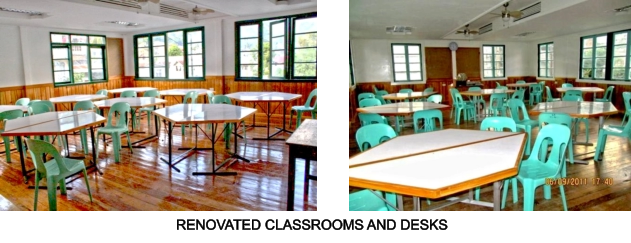


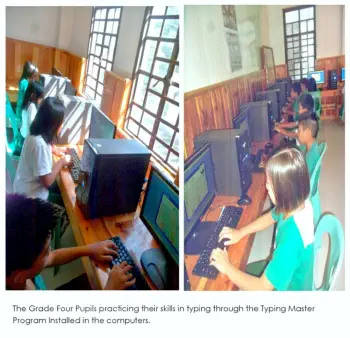
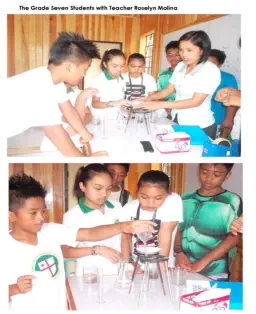
Science Laboratory
Typing Class at Computer Lab











Fund Raising Activities
So far ASMESAF-NA’s fund raising activites were as follows:
1.
General Solicitation
2.
Caroling
3.
Ayoweng concert
4.
Dinner Dance
5.
Golf Tournament 1
6.
Raffle Draw
7.
Golf Tournament 2
8.
Other Fund raisers
9.
Manila Golf Tournament
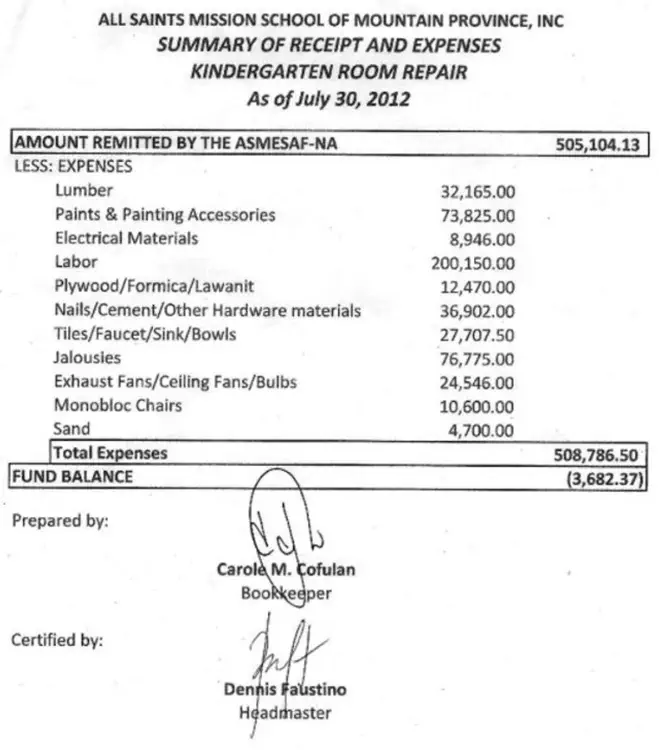
Fund Raising Activities
So far ASMESAF-NA’s fund raising activites were as follows:
1.
General Solicitation
2.
Caroling
3.
Ayoweng concert
4.
Dinner Dance
5.
Golf Tournament 1
6.
Raffle Draw
7.
Golf Tournament 2
8.
Other Fund raisers
9.
Manila Golf Tournament

Fund Raising Activities
So far ASMESAF-NA’s fund raising activites were as follows:
1.
General Solicitation
2.
Caroling
3.
Ayoweng concert
4.
Dinner Dance
5.
Golf Tournament 1
6.
Raffle Draw
7.
Golf Tournament 2
8.
Other Fund raisers
9.
Manila Golf Tournament
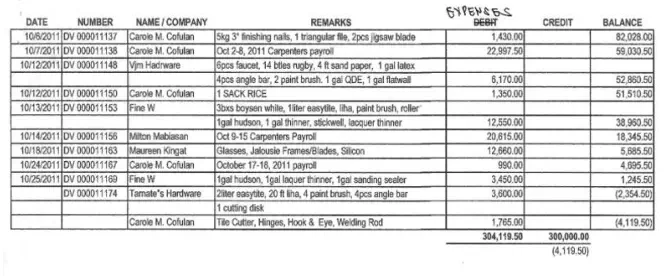


Fund Raising Activities
So far ASMESAF-NA’s fund raising activites were as follows:
1.
General Solicitation
2.
Caroling
3.
Ayoweng concert
4.
Dinner Dance
5.
Golf Tournament 1
6.
Raffle Draw
7.
Golf Tournament 2
8.
Other Fund raisers
9.
Manila Golf Tournament
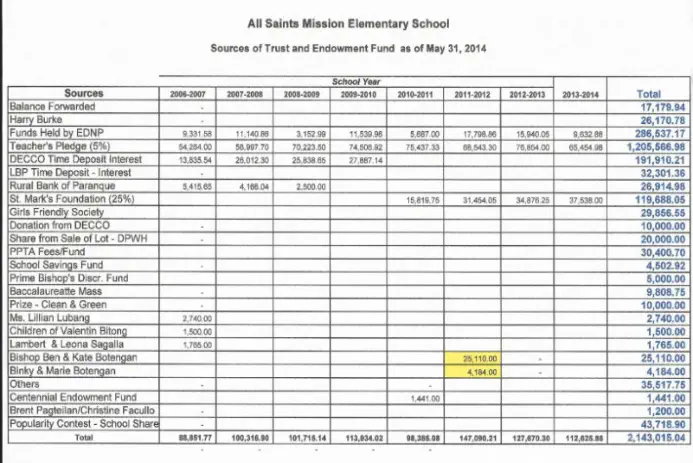
Fund Raising Activities
So far ASMESAF-NA’s fund raising activites were as follows:
1.
General Solicitation
2.
Caroling
3.
Ayoweng concert
4.
Dinner Dance
5.
Golf Tournament 1
6.
Raffle Draw
7.
Golf Tournament 2
8.
Other Fund raisers
9.
Manila Golf Tournament

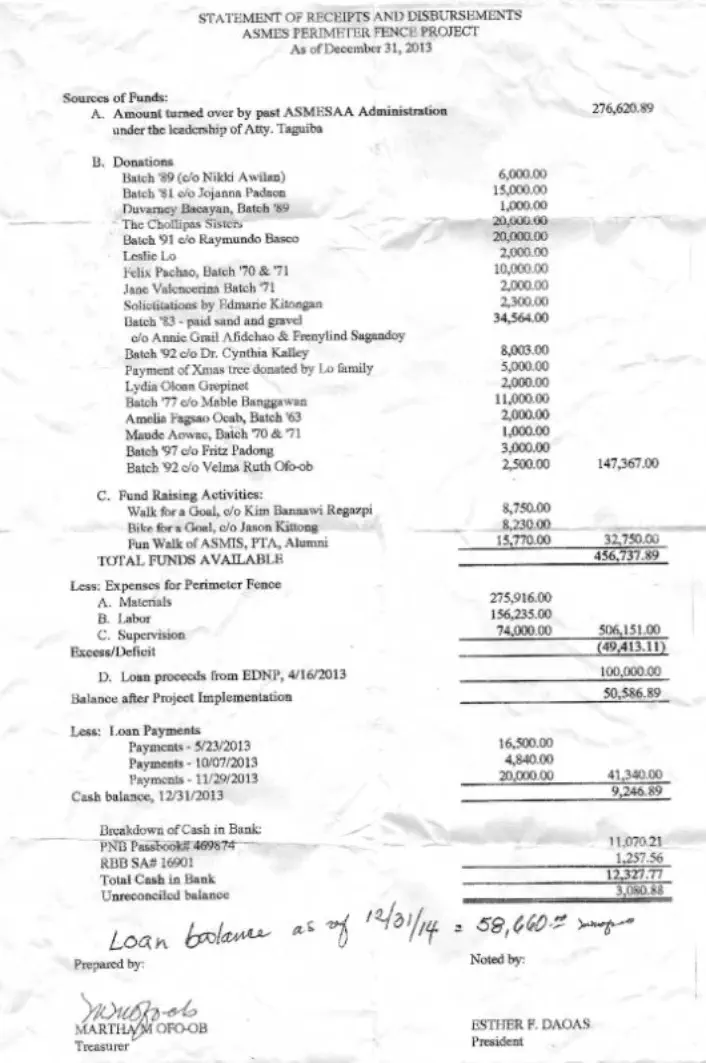


Fund Raising Activities
So far ASMESAF-NA’s fund raising activites were as follows:
1.
General Solicitation
2.
Caroling
3.
Ayoweng concert
4.
Dinner Dance
5.
Golf Tournament 1
6.
Raffle Draw
7.
Golf Tournament 2
8.
Other Fund raisers
9.
Manila Golf Tournament
Hereunder is the receipt of the 2nd and final remittance received by ASMIS from
ASMESAF-NA from the proceeds of the 2nd ASMESAF-NA Golf Tournament during its 1st
ever international reunion last March 6-8, 2015 in Alhambra, Califronia.
Science Laboratory receiptts and expenses


Fund Raising Activities
So far ASMESAF-NA’s fund raising activites were as follows:
1.
General Solicitation
2.
Caroling
3.
Ayoweng concert
4.
Dinner Dance
5.
Golf Tournament 1
6.
Raffle Draw
7.
Golf Tournament 2
8.
Other Fund raisers
9.
Manila Golf Tournament
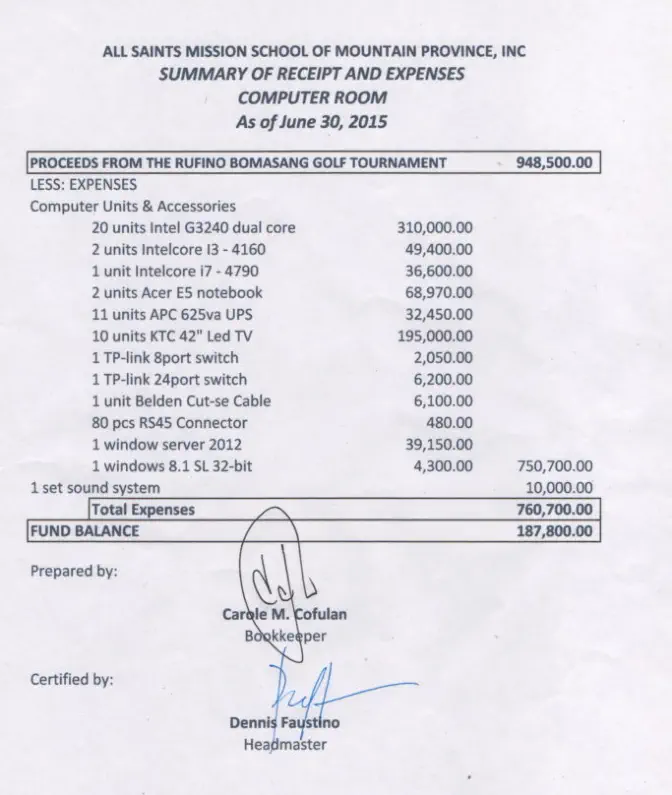
Computers and TV sets purchase


You can contact Dr. Dennis Faustino, the
Headmaster of All Saints Mission School of
Mountain Province, Inc. to verify information.
Email: dennis.faustino@gmail.com
You can also contact Bishop Brent Alawas of
the Episcopal Diocese of Northern Philippines.
Email: ednpbrent@yahoo.com
For information regarding ASMESAF-NA, you
can contact Lambert Sagalla, the ASMESAF-
NA Interim President and web master.
Email: ommayat@gmail.com
Please make donation checks payable to
ASMESAF-NA then mail to:
Florence Cabay,
ASMESAF-NA Treasurer
835 Turtle Creek Drive
Missouri City, TX 77489
Any donation amount is appreciated and
will be acknowledged with a receipt.
Using your check’s memo space, you
can designate your donation to any of
the following priority projects of All
Saints Mission School of Mountain
Province Inc (ASMIS):
•
ASMIS Building Fund
•
ASMIS Computer Lab
•
ASMIS Science Lab
•
ASMIS Endowment Fund
•
ASMIS Scholarship Fund
You can contact Florence Cabay via her:
•
Phone number: 832-244-4254
•
Email: cabayflor@yahoo.com



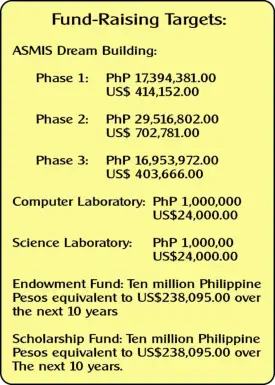
UNDER CONSTRUCTION
After browsing a link, use the back arrow of
your browser to return to the: asmesaf-na.org
website
For History Related Articles on All Saints Mission School,
Bontoc, Mountain Province Philippines, click on the following
hyperlinks:
•
The Making of ASMES
•
Origin and Growth
•
Centennial Homily
•
ASMES to ASMIS
UNDER CONSTRUCTION
For other slides, please go to: Galery
ASMIS Dream Building
Fund Raising Activities
So far ASMESAF-NA’s fund raising activites were as follows:
1.
General Solicitation
2.
Caroling
3.
Ayoweng concert
4.
Dinner Dance
5.
Golf Tournament 1
6.
Raffle Draw
7.
Golf Tournament 2
8.
Other Fund raisers
9.
Manila Golf Tournament
UNDER CONSTRUCTION
Contact Persons
All Saints Mission Elementary School
Alumni and Friends in North America, Inc.
ASMESAF-NA
Dr. Diman Felipe
President
email:
Manny Belgica
Vice President
email:
Benilda Comafay Bennet
Treasurer
email:
Ralyn Kis-ing Taguiba
Assistant Treasurer
email:
Abigail Capuyan Tauli
Secretary
email: lingayo@hotmail.com
Norwina Deleso Beaupre - Auditor
email:
Ernest Killip
ASMESAF-NA emailing group
owner/administrator.
email: entakokayet@verizon.net
Lambert Sagalla
Website Administrator
samping44@gmail.com
Chakayu ay balo ay opisyales
kompletoweno et na.
En anap kayu metland is
baru ay website administrator
To
ASMIS
alumni
and
friends
in
North
America
(i.
e.
USA and Candada),
It
is
good
to
know
that
you
are
re-organizing
ASMESAF-NA.
For
one
thing
the
name
ASMESAF-NA
should
be
changed
to
ASMIS-NA
to
reflect
the
inclusion
of
the
high school and kindergarten departments of the school.
This
website
can
serve
as
a
starting
point
for
a
new
website
for
asmis-na.org
.
Make
the
new
website
a
responsive
one
for
viewers
with
cellphones.
The
old
website is best viewed with a desktop or maybe laptop.
May the Good Lord guide you in this worthy endeavor.
Congratulations.
LBS